
Every year, as the days get shorter and the sun disappears behind clouds earlier, millions of people in the U.S. start feeling different - slower, heavier, irritable, or just plain down. It’s not just bad weather or a rough January. For about 5% of adults, this is seasonal affective disorder, or SAD - a real, diagnosable form of depression that follows the seasons like a clock. And for many, the answer isn’t more coffee or a vacation. It’s light.
What Exactly Is Winter Depression?
Seasonal affective disorder isn’t just feeling a little gloomy in December. It’s a recurring pattern of depression that starts in the fall, peaks in winter, and lifts in spring. Symptoms include constant fatigue, oversleeping, intense cravings for carbs, weight gain, and avoiding friends or activities you used to enjoy. People in northern states like Alaska or Minnesota are more likely to experience it - 5.1% of residents there report SAD, compared to just 1.4% in Florida. Women between 25 and 45 are most affected, making up nearly 70% of users of light therapy devices.The science behind it is clear: less daylight means your body’s internal clock, or circadian rhythm, gets thrown off. Your brain produces less serotonin - the chemical that lifts your mood - and more melatonin, the hormone that makes you sleepy. The result? A biological mismatch between your body’s needs and the environment. This isn’t laziness. It’s biology.
How Light Therapy Works
Bright Light Therapy (BLT) is the most researched, most recommended treatment for SAD. It’s not a fancy gadget or a placebo. It’s a scientifically proven method that mimics natural sunlight using a special lamp, called a light box. The first major study proving its effectiveness came out in 1984, led by Dr. Norman Rosenthal at the National Institute of Mental Health. Since then, over 850 patients across 11 clinical trials have confirmed its power.The standard protocol is simple: sit 16 to 24 inches away from a 10,000-lux light box for 30 minutes each morning, ideally within one hour of waking. You don’t stare at the light - you just have it on while you eat breakfast, read, or work on your laptop. The light enters your eyes indirectly, signaling your brain to cut back on melatonin and ramp up serotonin. Most people notice a difference in energy and mood within 3 to 7 days. By week two, many report feeling like themselves again.
Not all light boxes are created equal. The American Academy of Ophthalmology says devices must block nearly all ultraviolet (UV) light to protect your eyes. And intensity matters. A 2019 study in PubMed found that if a light box’s output drops more than 10% from its labeled lux level, it loses effectiveness. That’s why certified devices from brands like Carex, Verilux, and Northern Light Technologies are trusted - they’re tested to deliver consistent, therapeutic light.
How It Compares to Other Treatments
Some people turn to antidepressants like fluoxetine (Prozac) for winter depression. But light therapy has advantages. A 2006 study comparing BLT to fluoxetine in 96 patients found that light therapy worked faster. By week two, those using the light box showed significantly better mood improvements. By week eight, both treatments were equally effective - but light therapy had fewer side effects like nausea, weight gain, or sexual dysfunction.Compared to a placebo, the data is even clearer. Across 16 studies with 559 patients, light therapy was 1.42 times more likely to produce a positive response. In one classic study, 61% of SAD patients achieved remission with light therapy - meaning their depression score dropped below a clinical threshold - while only 32% did with a fake light box.
But it’s not perfect. For severe depression, light therapy alone isn’t always enough. And it doesn’t work for everyone. About 40-60% of people with SAD respond well, according to Dr. Rosenthal. That means nearly half may need to try other options - or combine light therapy with talk therapy or lifestyle changes.
Real People, Real Results
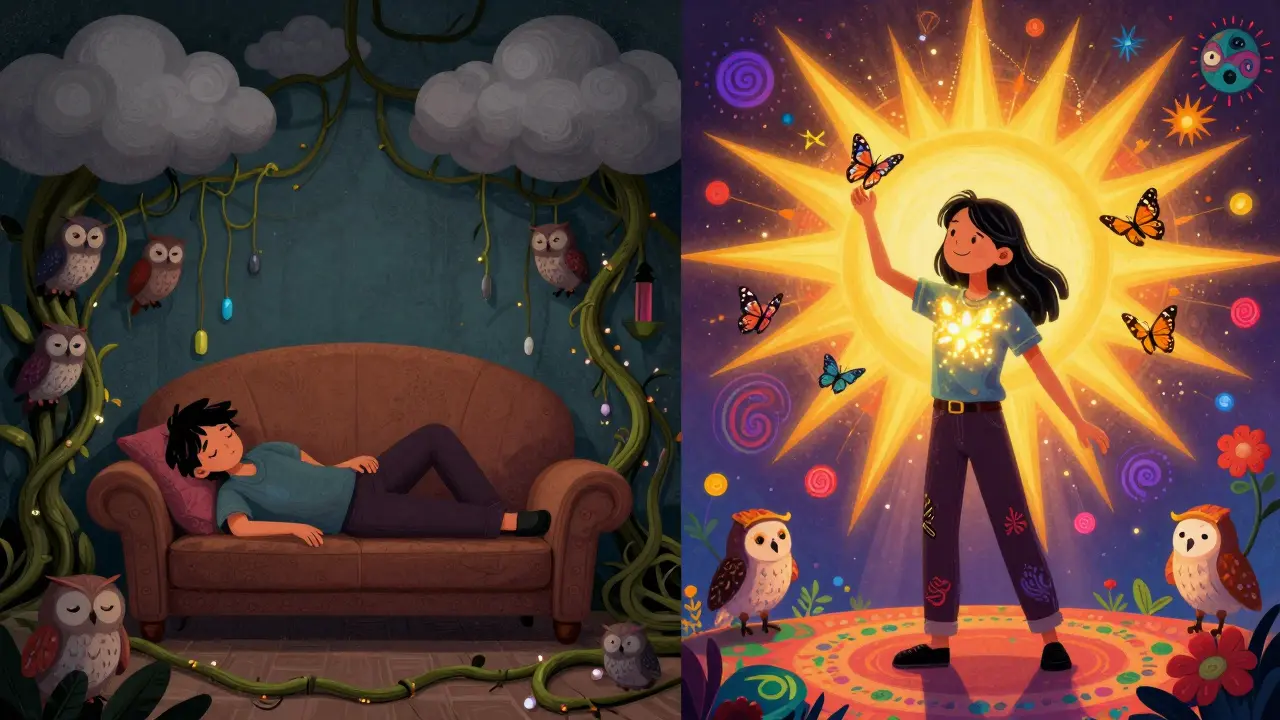
On Reddit’s r/SAD community, with over 145,000 members, stories flood in. One user, WinterSurvivor89, wrote: “After using my 10,000-lux light box every morning since October, my energy jumped in five days. My depression score dropped from 22 to 8.” That’s the kind of turnaround doctors see in clinics.But not everyone has success. LightBoxSkeptic, another user, said: “Tried three different boxes over two winters. No change. Just eye strain and frustration.” This isn’t rare. A 2023 NAMI survey found that 39% of users quit light therapy because it didn’t help - or because it was too hard to stick with.
On Amazon, the Carex Day-Light Classic Plus has over 2,850 reviews and a 4.4-star rating. Two-thirds of reviewers say they saw “significant improvement” in mood within two weeks. The most common praise? “Instant energy boost” and “no meds needed.” The biggest complaints? Eye strain and remembering to do it every morning.
How to Use It Right
Using a light box isn’t rocket science, but there are rules. First, timing matters more than you think. Morning exposure - between 6 a.m. and 8 a.m. - works best. Evening light can actually make sleep worse. Second, position the box slightly to the side, not directly in front. Your eyes should be open, but you don’t need to stare. Just let the light hit your retina while you’re awake and active.If you struggle with mornings - maybe you’re a night owl, or your schedule is unpredictable - consider a dawn simulator. These devices gradually brighten your room 30 minutes before your alarm, mimicking sunrise. They’re quieter and easier to stick with for some people. Portable light visors are another option, especially for people who travel or have mobility issues.
Most people get the hang of it in two or three tries. But consistency is key. Skipping days reduces effectiveness. The Center for Environmental Therapeutics (CET) offers free, science-backed guides on how to set up your routine - and they’re downloaded 15,000 times a month.
Who Shouldn’t Use It
Light therapy is safe for most people - including pregnant women and older adults - which is why it’s often preferred over antidepressants. But it’s not for everyone.If you have bipolar disorder, light therapy can trigger mania in 5-10% of cases. That’s why doctors always ask about mood swings before recommending it. The Mayo Clinic warns that people with a history of mania should only use light therapy under supervision.
People with certain eye conditions - like glaucoma, diabetic retinopathy, or retinal disease - should talk to an ophthalmologist first. Even though UV light is filtered out, the intensity could still be risky for damaged retinas.
What’s New in Light Therapy
The field is evolving. In 2024, a major study in JAMA Psychiatry showed that light therapy also works for non-seasonal depression. Patients with regular depression - not tied to seasons - had a 41% remission rate with light therapy, compared to 23% in control groups. That’s a game-changer.The FDA even approved the first prescription light device, the Aura Light System, in February 2024, specifically for treatment-resistant depression. Wearable devices like the Luminette 3 - glasses that deliver light directly to the eyes - are growing fast, with sales up 200% in 2023. And researchers at Stanford are testing AI-powered light therapy that adjusts intensity and timing based on your body’s natural rhythms. Trials will wrap up in late 2025.
But there’s a catch. A Consumer Reports test in January 2024 found that 37% of cheaper, non-certified light boxes didn’t deliver the promised lux levels. You can’t trust every product on Amazon. Look for devices that meet CET standards - or at least list their lux output clearly and mention UV filtration.
Cost, Insurance, and Access
Most light boxes cost between $100 and $200. Premium models with dawn simulation or adjustable settings run up to $300. Insurance rarely covers them - only 18% of U.S. plans do. But some, like Aetna, now cover up to $200 with a doctor’s note. That’s a step forward.The global market for these devices is booming. It was worth $587 million in 2023 and is expected to hit $1.12 billion by 2028. North America leads the way, not just because of cold winters, but because awareness is growing.
What to Do Next
If you’ve been feeling sluggish, heavy, or down every winter for years - and it’s affecting your work, relationships, or sleep - it’s time to consider light therapy. Start by talking to your doctor. Rule out other causes like thyroid issues or sleep apnea. Then, get a certified light box. Don’t wait for January. Begin in early fall, before symptoms hit hard.There’s no magic pill. But for millions, a simple box of light has been the key to getting their winter back. It’s not a cure-all. But it’s one of the few treatments that works fast, safely, and without side effects. And sometimes, that’s enough.
Is light therapy effective for everyone with seasonal depression?
No, light therapy works for about 40% to 60% of people with seasonal affective disorder. Response varies based on timing, intensity, and individual biology. Some people need to combine it with talk therapy or lifestyle changes. If you don’t notice improvement after two weeks of consistent use, consult your doctor.
Can I use a regular lamp or LED bulb instead of a light therapy box?
Regular lamps or LED bulbs don’t provide the right intensity or spectrum. Light therapy boxes deliver 10,000 lux - about 20 times brighter than typical indoor lighting. They’re also designed to filter out harmful UV rays. Using a regular lamp won’t trigger the same biological response and could strain your eyes without helping your mood.
How long should I use light therapy each day?
The standard recommendation is 30 minutes per day at 10,000 lux. Some people need as little as 20 minutes, while others benefit from up to 60 minutes - especially if using a lower-intensity box (like 2,500 lux). Always follow the device’s instructions and aim to use it within one hour of waking. Consistency matters more than duration.
Can light therapy cause eye damage?
Properly designed light therapy boxes filter out nearly all ultraviolet (UV) radiation, making them safe for the eyes. The American Academy of Ophthalmology confirms that these devices pose no risk to healthy eyes when used correctly. However, people with pre-existing eye conditions like glaucoma or retinal disease should consult an eye specialist before starting.
Is it safe to use light therapy if I have bipolar disorder?
Light therapy can trigger manic episodes in 5% to 10% of people with bipolar disorder. If you have bipolar disorder, you should only use light therapy under the supervision of a mental health professional. They can help you monitor your mood and adjust timing or intensity to reduce risks.
Can light therapy help with non-seasonal depression?
Yes. A 2024 study in JAMA Psychiatry found that light therapy led to a 41% remission rate in people with non-seasonal major depression - compared to 23% in control groups. This suggests light therapy may be useful beyond winter depression, especially for those who don’t respond well to medications.

I used to think SAD was just an excuse to eat more carbs and curl up under blankets. Then I got hit with a winter so dark I couldn’t even motivate myself to shower. Light therapy? Game. Changer. I didn’t believe it until day three - suddenly I was making coffee without crying. No meds. No guilt. Just a dumb box that saved my life.
It is worth noting that the biological mechanism underlying seasonal affective disorder is not merely a function of photoperiod, but rather an intricate interplay between circadian entrainment, serotonergic regulation, and melatonin suppression. The efficacy of light therapy, therefore, is not anecdotal, but grounded in neuroendocrinological evidence dating back to Rosenthal’s seminal 1984 study. One might even argue that the modern human’s disconnection from natural diurnal cycles - through artificial lighting and screen exposure - has exacerbated this condition. Light therapy, then, is not a Band-Aid, but a recalibration of our evolutionary biology.
OMG YES!! I’m from India and we don’t really talk about SAD here - everyone just says ‘it’s winter, be chill!’ But when I moved to Seattle? I turned into a zombie. 😭 My mom sent me a light box from Amazon and I was skeptical… until I used it while sipping chai. Within 4 days? I was dancing in the kitchen again. 💃✨ Light isn’t just light - it’s a hug from the sun. 🌞❤️
Let’s be real - 40-60% response rate? That’s basically a coin flip. And yet everyone acts like it’s magic. What about the other half? The ones who spend $200, sit there for 30 minutes, and feel like they just wasted their morning? No one talks about that. And why are we all pretending this isn’t just glorified LED therapy for people who hate winter? It’s not a cure. It’s a distraction.
YESSSSS!! I’ve been using my Carex box since October and I’m basically a new person!! 😍 I used to nap at 3 p.m. every day - now I’m out hiking on weekends!! And the best part? No side effects!! 🌞✨ I even started a morning routine: light box + coffee + 5 mins of stretching. It’s my little ritual. If you’re on the fence - just try it for 10 days!! You’ve got nothing to lose!! 💪💛
light therapy? more like light scam. you pay 200 bucks for a lamp that says "10,000 lux" but if you squint real hard you can see the plastic. i tried 3 diffrent ones. 1 gave me migranes. 1 made me feel like a lab rat. 1 i just used to read fanfic. no magic. just corporate marketing with a glow stick. also, who even has time to sit still for 30 mins in the morning? i’m already late for work. this isn’t therapy. it’s a productivity cult.
While the data presented in the article is compelling, particularly the 2024 JAMA Psychiatry study, one must consider potential publication bias in clinical trials. Many studies are funded by manufacturers of light therapy devices. Additionally, the placebo effect may be amplified by the ritualistic nature of the practice - the act of sitting with a device may itself confer psychological benefit independent of photic input. A more rigorous meta-analysis is warranted.
As a Canadian who has lived through 17 consecutive winters, I can attest that light therapy is not a panacea - but it is one of the few tools we have that doesn’t involve pharmaceuticals or relocation. I use a dawn simulator now. It’s quieter, less intrusive, and fits into my chaotic life. The science is solid. The cultural silence around SAD? That’s the real problem.
I don’t believe in this light box nonsense. I’ve lived in South Africa for 10 years - we get sun every day. Why do Americans act like winter is the end of the world? Just go outside. Walk. Breathe. Move. You don’t need a gadget. You need discipline. Or maybe you just need to stop being so soft.
Okay, so… I’ve been using light therapy for 3 years. I’m one of the 60% who actually benefit. BUT. I also have bipolar disorder. And yes - I had a manic episode last winter. 😬 My psychiatrist told me to stop. I didn’t. I reduced time to 15 mins. Now I use it at noon. It’s still helping. So… yeah. It’s complicated. Don’t just trust the article. Talk to your doctor. And maybe keep a mood journal. I do. And I cry. A lot. But I’m alive. 🥲
For anyone hesitating - start small. Use your phone’s flashlight at 6 a.m. for 5 minutes while brushing your teeth. Then add 5 more. Then get a $50 box on Amazon. Don’t wait for perfection. Progress > perfection. You’re not lazy. You’re not broken. You’re just out of sync. And light? It’s the gentlest, most powerful reset button we have. 💛 You’ve got this.