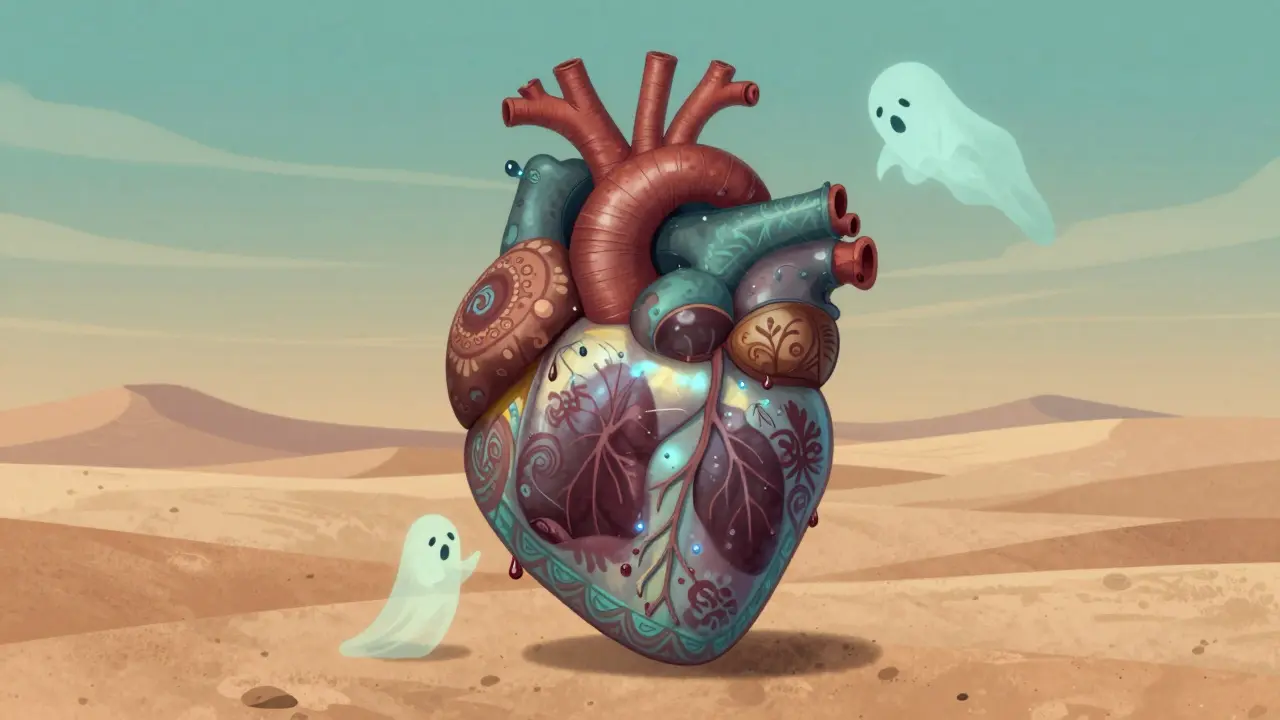
When your heart muscle stops working the way it should, it’s not just about feeling tired. It’s about your whole body struggling to get the oxygen and blood it needs. Cardiomyopathy isn’t one disease-it’s a group of conditions that directly weaken or stiffen the heart muscle. The three main types-dilated, hypertrophic, and restrictive-each mess with the heart in different ways, and knowing the difference can mean the difference between managing symptoms and facing life-threatening complications.
Dilated Cardiomyopathy: The Enlarged, Weak Pump
Dilated cardiomyopathy (DCM) is the most common type, making up about half of all cases. Imagine your heart’s main pumping chamber-the left ventricle-stretching out like an overinflated balloon. Instead of squeezing tightly to push blood out, it flaccidly pumps, often sending less than half the normal amount with each beat. Ejection fraction drops below 40%, and the chamber swells past 55 mm in men or 50 mm in women. Walls thin to under 10 mm, even though the chamber is huge.
This isn’t just about size. The muscle itself loses strength. Blood backs up into the lungs and liver, causing shortness of breath, swelling in the legs, and extreme fatigue. About 35% of DCM cases have no clear cause-called idiopathic. Another third are linked to past viral infections, like coxsackievirus, which triggers inflammation that never fully heals. Chronic alcohol abuse-more than 80 grams a day for five years-is a major trigger. Chemotherapy drugs like doxorubicin can also damage heart cells over time.
Genetics play a big role too. Around one in three people with DCM have family members with the same issue, often due to mutations in genes like TTN or LMNA. That’s why doctors now recommend genetic testing if there’s a family history. The good news? Modern treatments work. A combination of drugs like sacubitril/valsartan (brand name Entresto), beta-blockers, and SGLT2 inhibitors (originally for diabetes) can cut death risk by 30% over three years. In fact, patients on this regimen often report feeling like they’ve got their energy back.
Hypertrophic Cardiomyopathy: The Thickened, Stiff Muscle
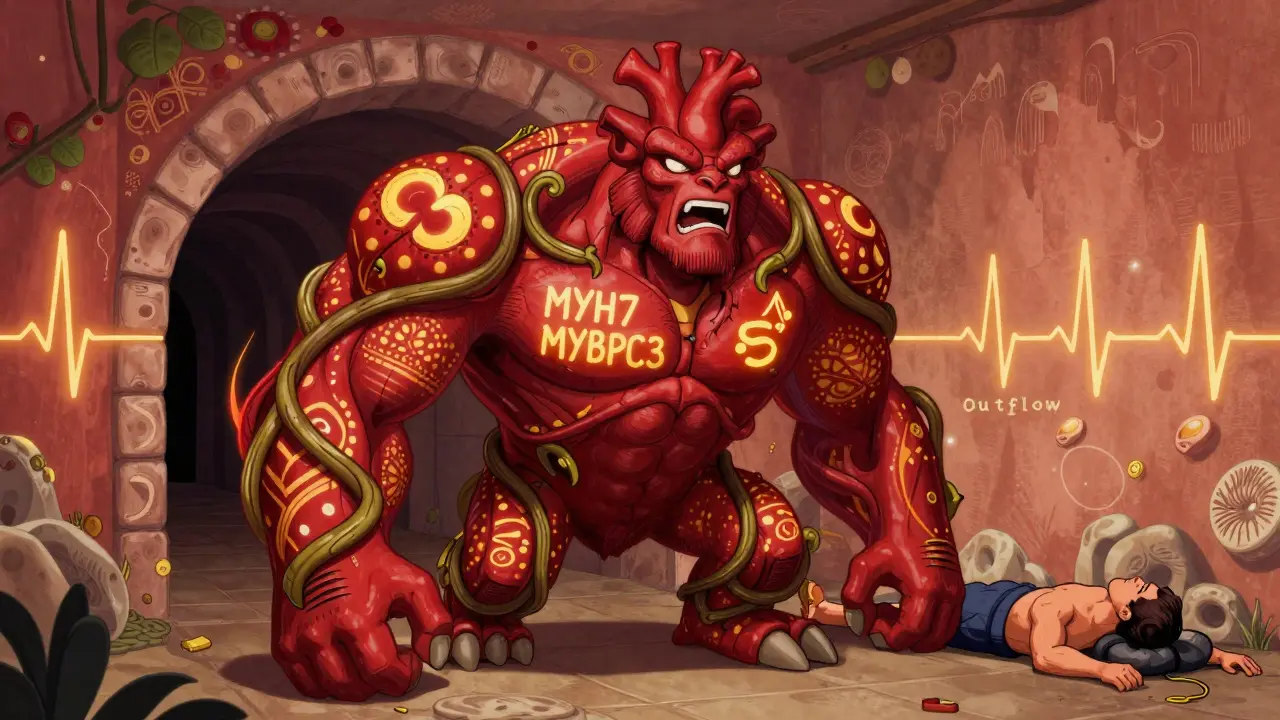
Hypertrophic cardiomyopathy (HCM) looks the opposite of DCM. Instead of stretching, the heart muscle thickens-sometimes dramatically. Walls of the left ventricle hit 15 mm or more, often with the septum (the wall between the two lower chambers) bulging more than the opposite side. This isn’t from high blood pressure or valve problems. It’s the muscle itself growing abnormally, usually because of inherited mutations in genes like MYH7 or MYBPC3.
What makes HCM dangerous isn’t just the thickness-it’s how it blocks blood flow. In 70% of cases, the thickened muscle squeezes the outflow tract, forcing the heart to work harder just to pump blood out. This causes a pressure gradient over 30 mmHg, leading to dizziness, chest pain, and fainting, especially during exercise. It’s the top cause of sudden cardiac death in young athletes under 35. That’s why many schools now require EKGs before sports participation.
But not everyone with HCM has symptoms. Some people live their whole lives without knowing they have it. That’s why family screening matters. If one person is diagnosed, first-degree relatives should get checked. A 17-gene panel test costs between $1,200 and $2,500 in the U.S., and it finds a genetic cause in about 60% of cases.
Treatment has improved dramatically. Beta-blockers help most people by slowing the heart and reducing strain. For those with severe blockage, disopyramide can reduce the obstruction. But the real game-changer is mavacamten (Camzyos), approved in 2022. It directly targets the overactive heart muscle proteins and cuts the outflow gradient by 80% in most patients. For those who don’t respond, a procedure called septal myectomy or alcohol ablation can remove or shrink the thickened area. Around 85% of these patients report immediate relief.
Restrictive Cardiomyopathy: The Stiff, Unyielding Heart
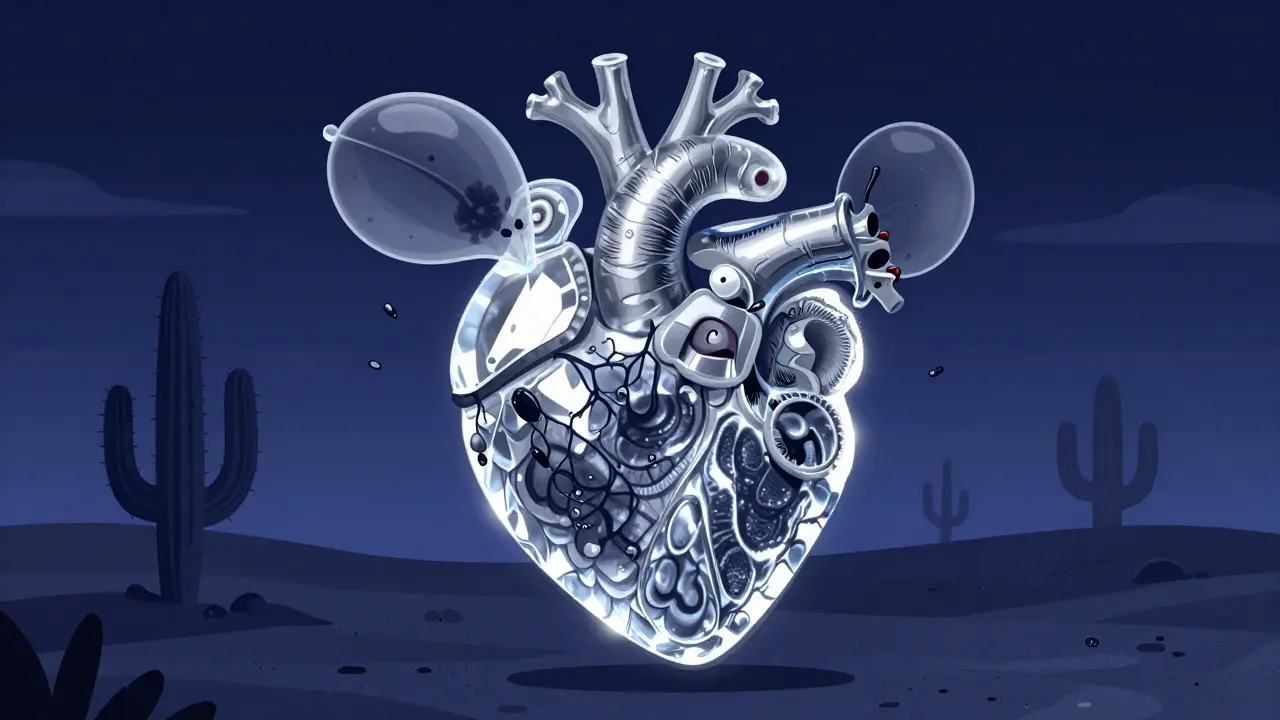
Restrictive cardiomyopathy (RCM) is the rarest of the three, making up less than 5% of cases. Unlike the other types, the heart muscle doesn’t get thick or stretched-it just gets stiff. Think of it like a heart wrapped in plastic wrap. It can still squeeze well (ejection fraction stays above 50%), but it can’t relax enough to fill with blood between beats.
This leads to a backup of blood in the lungs and veins, causing swelling, fatigue, and fluid buildup. The key clue? The ventricles stay small, but the atria (upper chambers) balloon out. Echocardiograms show a telltale pattern: the E/A ratio spikes above 2, and the blood flow decelerates in under 150 milliseconds.
RCM is almost always caused by something else invading the heart. Amyloidosis is the biggest culprit-60% of cases. Proteins called amyloids build up like scar tissue, making the muscle rigid. Sarcoidosis (inflammatory lumps), hemochromatosis (iron overload), and Fabry disease (a rare genetic storage disorder) are other common causes. Diagnosing RCM is tricky. Many doctors miss it because it looks like constrictive pericarditis-a condition where the sac around the heart stiffens instead. Cardiac MRI with late gadolinium enhancement is key here: if you see patchy, non-coronary scarring, it’s likely RCM.
Treatment depends entirely on the root cause. For amyloidosis, drugs like tafamidis or daratumumab can slow the protein buildup. Tafamidis costs over $225,000 a year in the U.S., but it improves walking distance by 25 meters in six months. For hemochromatosis, regular blood removal (phlebotomy) can reverse damage if caught early. The hard truth? RCM has the worst prognosis. Five-year survival ranges from 30% to 50%, depending on what’s causing it. That’s why early detection through family history and targeted testing is critical.
Why Classification Matters
The old way of diagnosing cardiomyopathy just looked at how the heart looked on an echo. Now, doctors look at why it changed. Is it genetic? Toxic? Inflammatory? That changes everything.
For example, if a 40-year-old man has DCM and tests positive for a TTN gene mutation, his siblings and children need screening-even if they feel fine. If a 65-year-old woman with HCM has no family history but tests negative for sarcomere mutations, her doctors might look harder for other causes, like long-standing high blood pressure or even undiagnosed thyroid disease.
And RCM? If you mistake it for constrictive pericarditis, you might send someone for heart surgery they don’t need. But if you catch amyloidosis early, you can start treatment that adds years to life.
That’s why the American Heart Association now says terms like “ischemic cardiomyopathy” are misleading. If your heart muscle is weak because of a blocked artery, that’s coronary artery disease-not a primary heart muscle disease. Treating the blockage with stents or meds is the answer, not just pumping you full of heart failure drugs.
What’s Next
Research is moving fast. CRISPR gene editing is entering early trials for HCM, targeting the MYBPC3 mutation. In 2024, the VERVE-201 trial began testing a one-time treatment that edits the faulty gene in liver cells to reduce abnormal protein production. If it works, it could stop HCM before symptoms even start.
For DCM, gene therapies using viral vectors to deliver healthy genes into heart cells are in Phase II trials. And for RCM, new blood tests that detect amyloid proteins before organ damage occurs could become routine in five years.
But right now, the biggest barrier isn’t science-it’s access. Only 35% of community hospitals correctly classify these types. Rural areas often lack specialists who know how to order the right tests. A patient in Flagstaff, Arizona, might have to drive three hours to get a cardiac MRI or genetic counseling.
That’s why awareness matters. If you’ve got unexplained shortness of breath, fainting during exercise, or a family history of sudden cardiac death before age 50-get checked. Not every heart problem is a heart attack. Sometimes, it’s the muscle itself that’s broken.
Can you live a normal life with cardiomyopathy?
Yes, many people do-with the right treatment. People with dilated cardiomyopathy on modern drug regimens often return to work, exercise, and normal activities. Those with hypertrophic cardiomyopathy can live full lives, especially if they avoid intense competitive sports and take medications like beta-blockers. Restrictive cardiomyopathy is trickier, but treating the underlying cause (like amyloidosis) can extend life significantly. The key is early diagnosis and sticking with treatment.
Is cardiomyopathy hereditary?
In many cases, yes. About 25-35% of dilated cardiomyopathy cases, 60% of hypertrophic cases, and a smaller percentage of restrictive cases have a genetic link. If a close family member has been diagnosed, first-degree relatives should be screened with an echocardiogram and possibly genetic testing. Even if they feel fine, they might carry the gene and need monitoring.
Can exercise make cardiomyopathy worse?
It depends on the type. For hypertrophic cardiomyopathy, intense competitive sports can trigger sudden death, so doctors usually restrict high-intensity activity. For dilated cardiomyopathy, moderate aerobic exercise like walking or cycling is often encouraged-it improves heart efficiency. With restrictive cardiomyopathy, exercise tolerance is limited by symptoms, so activity should be guided by a cardiologist. Always get clearance before starting or changing your routine.
What tests are used to diagnose each type?
Echocardiography is the first step for all types. For dilated, it shows enlarged chambers and low ejection fraction. For hypertrophic, it reveals thickened walls and outflow obstruction. For restrictive, it shows stiff filling patterns and normal ejection fraction. Cardiac MRI adds detail on tissue scarring and muscle thickness. Genetic testing helps confirm inherited causes. In restrictive cases, biopsy or blood tests for amyloid proteins may be needed.
Are there new treatments on the horizon?
Absolutely. For hypertrophic cardiomyopathy, mavacamten (Camzyos) is already approved and reduces obstruction. Gene therapies using CRISPR are entering human trials. For dilated, gene-based treatments like AAV1/SERCA2a are being tested to restore heart cell function. For restrictive, drugs like tafamidis and daratumumab target amyloid buildup. These aren’t cures yet, but they’re shifting the outlook from symptom management to disease modification.
Just wanted to say this post is one of the clearest breakdowns of cardiomyopathy I’ve ever read. I’m a nurse, and even I learn something new every time I revisit this. The way you tied genetics to treatment options? Chef’s kiss.
This is exactly why I push my patients to get genetic counseling if they have unexplained heart failure. So many still think it’s just ‘bad luck’ or ‘aging.’ But no - if Mom had DCM and died at 48, her kids need to know before they collapse on the treadmill.
My 52-year-old client just found out she carries a TTN mutation after her dad’s sudden death. She’s on Entresto now. Her ejection fraction went from 28% to 45% in six months. It’s not magic - it’s science.
Let’s be real - most of this is just pharmaceutical marketing dressed up as medicine. They don’t want you cured. They want you on lifelong drugs. Mavacamten? $20,000 a year. Tafamidis? $225K. Who’s really benefiting here? The investors.
And don’t get me started on gene therapy. CRISPR? That’s not science - it’s playing God. What happens when we edit one gene and accidentally trigger cancer elsewhere? We’re not ready. We’re not ready at all.
My cousin had HCM. He stopped taking beta-blockers. Started yoga. Ate turmeric. Now he’s hiking in Nepal. No stents. No drugs. Just ancestral wisdom.
Modern medicine is a pyramid scheme. The patients pay. The corporations profit. The doctors get bonuses. The truth? Your heart doesn’t need a lab report. It needs rest. And silence.
Oh wow. So the guy who wrote this is either a cardiologist or a very well-read TikTok algorithm.
Also - ‘cardiac MRI with late gadolinium enhancement’? That’s the kind of phrase that makes me want to hug my doctor… or punch them. Depends on their coffee game.
But seriously - this is gold. I showed it to my dad. He’s 68, has DCM, and thought he was just ‘getting old.’ Now he’s asking for genetic testing. And I’m not even his kid. I’m his neighbor. He asked me to text him ‘the heart thing’ again.
Also - tafamidis costs more than my car. Who’s paying for this? The government? My taxes? I’m not mad. I’m just… confused.
Thank you. Thank you. Thank you.
I’ve spent the last three years trying to explain to my sister that her ‘fatigue’ isn’t just ‘stress.’ She finally got tested. Turns out - RCM. Amyloidosis. We caught it early. She’s on tafamidis. Her lungs aren’t filling with fluid anymore. She’s back to gardening.
Doctors missed it. Twice. Because ‘ejection fraction was normal.’
So thank you for writing this. I’m sharing it with every doctor’s office I walk into.
Did you know that the American Heart Association’s guidelines were funded by Novartis, Merck, and Roche? I do. I’ve read the disclosures. Every ‘breakthrough’ you mention? Paid for by the same companies selling the drugs.
And CRISPR trials? They’re being run in private clinics outside the U.S. - because regulators won’t approve them. Why? Because they’re scared of liability. Or maybe… they’re scared of the truth.
What if the real cause of HCM isn’t genetics? What if it’s glyphosate? Or 5G? Or microplastics in our water? We’re told to test genes… but no one tests the environment.
I’ve been tracking this since 2018. And I’m not buying it.
bro this post is a whole vibe 😭
i had a cousin with hcm. he died at 22. no warning. no symptoms. just… gone.
now my sister got tested. she’s positive. we’re all freaked out. but at least we know. thank u for this. i’m sharing with my whole fam.
also… mavacamten sounds like a superhero name. 🦸♂️
While the post is overwhelmingly accurate and well-researched, I’d like to add a nuance often overlooked: socioeconomic access disparities. The fact that a patient in Flagstaff must drive three hours for an MRI isn’t an anomaly - it’s systemic. In rural Alabama, Georgia, or Montana, patients often wait 11 months for a genetic counselor. And even when they get one, insurance denies coverage for the 17-gene panel - calling it ‘experimental.’
Meanwhile, urban academic centers are already running CRISPR trials. This isn’t just a medical issue - it’s a justice issue. We’re creating a two-tiered system: those who can afford early diagnosis, and those who die waiting.
Policy change must follow science. Otherwise, we’re just giving beautiful lectures while people drown.
I read this at 3 a.m. after my mom had another ER visit for ‘fluid in her lungs.’ They kept saying ‘it’s just congestion.’ But I knew. I’d read about RCM. I’d seen the E/A ratio spike in the echo report. I printed this post. I handed it to the resident. He said, ‘Hmm. Interesting.’ Then he ordered the cardiac MRI.
Turns out - amyloid light-chain. We caught it before her kidneys gave out.
I didn’t know what to do. So I googled. And I found this.
I don’t know who wrote this… but you saved my mom.
I’m crying. I’m so, so grateful.
It is a matter of profound concern that the Western medical paradigm continues to prioritize pharmacological intervention over holistic physiological restoration. The human myocardium, a marvel of evolutionary engineering, does not respond optimally to synthetic compounds. The very notion of replacing endogenous protein function with exogenous drugs - such as sacubitril/valsartan or mavacamten - represents a fundamental misalignment with biological integrity.
Moreover, the genetic determinism espoused herein ignores the epigenetic influence of environmental stressors, including electromagnetic fields, heavy metal accumulation, and chronic psychological distress. One cannot reduce cardiomyopathy to a single gene mutation when the organism is immersed in a toxic milieu.
True healing requires detoxification, ancestral dietary protocols, circadian alignment, and vibrational medicine. The fact that these are dismissed as ‘alternative’ is evidence of institutional corruption.
My uncle, a retired cardiac surgeon, reversed his HCM through fasting, cold exposure, and Himalayan salt. No drugs. No surgery. Just discipline.
Modern medicine is a cathedral built on sand.
Look, I’ve been in cardiology for 18 years. I’ve seen everything. This post? It’s textbook. But here’s what nobody says: most people with HCM never get diagnosed because their echo looks ‘normal’ until they drop dead at a soccer game.
And guess what? The EKG they do at school? It misses 30% of cases. That’s not a flaw - it’s a failure.
My brother died at 24. He was ‘healthy.’ He ran marathons. No one thought to test him. Because ‘he looked fine.’
So now I push every high school athlete I meet to get a cardiac MRI. Even if they’re ‘fine.’ Even if they’re ‘just a kid.’
Because one test could save a life. And if you’re not doing it? You’re not trying hard enough.
My dad had DCM. He was told to ‘take it easy.’ So he stopped walking. Stopped talking. Stopped living.
We found this article two months before he died. We showed it to his doctor. He said, ‘We can try Entresto.’
He lived 14 more months. He walked the dog. He ate pancakes. He laughed.
I don’t know who wrote this. But you gave him back his last days.
Thank you.