
Wilson’s disease isn’t something most people hear about until it’s too late. It’s rare-about 1 in 30,000 people have it-but if left untreated, it can destroy your liver, scramble your brain, and even kill you. The problem isn’t eating too much copper. It’s your body’s inability to get rid of it. And that’s where chelation therapy comes in-not as a cure, but as a lifeline.
What Happens When Your Body Can’t Flush Out Copper
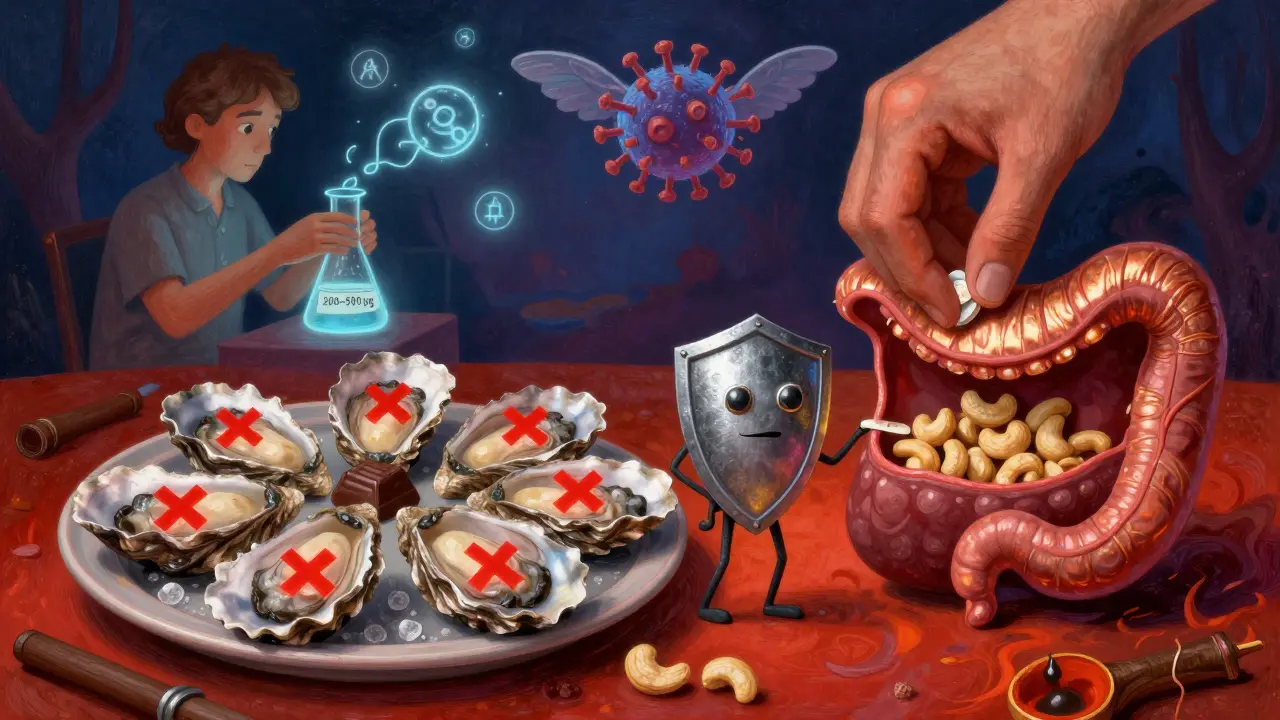
Every day, you absorb a little copper from food-nuts, shellfish, organ meats, chocolate, even tap water. Normally, your liver handles it. A protein called ATP7B grabs copper, wraps it into ceruloplasmin (the main copper carrier in your blood), and shoves the rest into bile to be pooped out. In Wilson’s disease, that protein is broken. Mutations in the ATP7B gene mean copper doesn’t get packaged or excreted. So it piles up.
At first, your liver tries to protect itself. Metallothionein, a copper-trapping protein, soaks up the excess. But once it’s full, copper leaks into your bloodstream. That’s when things go south. Free copper doesn’t care where it goes. It settles in the brain-especially the basal ganglia, the part that controls movement. It stains the cornea, forming greenish-brown rings around the iris called Kayser-Fleischer rings. It damages kidneys. And it turns your liver into a toxic wasteland.
By the time symptoms show up-fatigue, jaundice, shaky hands, trouble speaking-you’re already in trouble. The average person waits almost three years before getting diagnosed. Many are misdiagnosed with autoimmune hepatitis because the liver enzymes look the same. But here’s the difference: in Wilson’s disease, ceruloplasmin levels are low (under 20 mg/dL), and your urine is flooded with copper-often over 100 micrograms per day, sometimes way higher.
Why Chelation Therapy Isn’t Just a Pill-It’s a Lifesaving Routine
Chelation therapy isn’t magic. It’s chemistry. Chelators are molecules that grab onto copper like a claw and carry it out through urine. The two main drugs are D-penicillamine and trientine. Both work, but they’re not gentle.
D-penicillamine has been around since the 1950s. It’s cheap-about $300 a month-and the most common first choice. But it’s also notorious. About half of patients get worse at first. Their tremors spike. Their speech gets slurred. Why? Because as copper is pulled from the liver, it briefly surges into the brain. That’s why doctors now pair it with zinc from day one. Zinc tells your gut to stop absorbing copper, slowing the flood.
Trientine is gentler on the nervous system. It doesn’t cause that initial worsening as often. But it costs nearly six times as much-around $1,850 a month. Most insurance covers it, but not always. And it can cause iron deficiency in over a third of users. That means you might need iron supplements, which then need careful timing because iron interferes with copper chelation.
Then there’s zinc acetate. It’s not a chelator. It’s a shield. Zinc makes your intestinal cells produce metallothionein, which traps copper before it even enters your blood. It’s perfect for maintenance after the initial copper dump is cleared. But it doesn’t pull copper out of your brain or liver. That’s why you can’t start with zinc alone if you’re already symptomatic.

The Real Challenges: Side Effects, Diet, and Lifelong Monitoring
Patients don’t just take pills. They live by a strict routine.
- Take chelators on an empty stomach-two hours before or after food. Eating ruins absorption.
- Avoid high-copper foods: liver, oysters, cashews, mushrooms, dark chocolate, lentils, and even some multivitamins.
- Test your urine every six months. Target: 200-500 micrograms per day. Too low? You’re deficient. Too high? Copper’s still leaking.
- Check your free copper in blood every three months. Goal: under 10 micrograms per deciliter.
- Watch for side effects: skin rashes, kidney damage, lupus-like symptoms from penicillamine, or anemia from trientine.
One patient on Reddit said he switched from penicillamine to zinc after his kidneys started failing. Within six months, his liver enzymes dropped from 145 to 38. Another said he missed doses for months because the metallic taste made him gag. That’s the reality. These drugs aren’t easy. And they’re lifelong.
New Hope: What’s Coming Next
There’s progress. In 2023, a new drug called CLN-1357-a copper-binding polymer-showed an 82% drop in free copper without triggering neurological side effects. That’s huge. Another drug, WTX101 (bis-choline tetrathiomolybdate), got breakthrough status from the FDA after a 2022 trial showed it prevented neurological decline in 91% of patients, beating trientine’s 72%.
And then there’s gene therapy. Researchers injected a healthy version of the ATP7B gene into six patients using a harmless virus. Early results show it’s safe. No one’s cured yet, but the liver started producing the missing protein. It’s still early, but it’s the first real shot at fixing the root cause-not just managing the symptoms.
Europe is ahead here. In 2022, the EMA approved Decuprate, a form of tetrathiomolybdate that crosses the blood-brain barrier better than anything before. In the U.S., it’s still experimental. But for patients with severe neurological symptoms, that’s a game-changer.
How to Know If You or Someone You Know Might Have It
Wilson’s disease doesn’t care about age. It hits kids as young as 5 and adults up to 35. But symptoms vary wildly. Some start with liver problems-jaundice, swelling, nausea. Others have tremors, trouble swallowing, depression, or even psychiatric symptoms like sudden mood swings.
If you have unexplained liver issues, neurological symptoms, or a family history, ask for:
- A blood test for ceruloplasmin (low = red flag)
- A 24-hour urine copper test (over 80-100 μg = suspicious)
- An eye exam for Kayser-Fleischer rings (done with a slit lamp)
- Genetic testing for ATP7B mutations (definitive proof)
And don’t wait. The earlier you catch it, the better your chances. Someone diagnosed before symptoms? They can live a normal life. Someone diagnosed after brain damage? Recovery is partial, at best.
What Happens If You Don’t Treat It
Left untreated, Wilson’s disease kills. Liver failure. Neurological collapse. Coma. Death. There’s no natural recovery. The body doesn’t heal itself. Copper keeps building. Even if you feel fine, it’s still eating away at your organs.
But here’s the flip side: with treatment, life expectancy is normal. You can work, travel, have kids. You just need to take your pills, get your tests, and avoid that chocolate bar. It’s not glamorous. But it’s doable.
Wilson’s disease isn’t just a medical oddity. It’s a reminder that some diseases are silent until they’re devastating. And sometimes, the difference between life and death isn’t a miracle drug-it’s a simple test, a timely diagnosis, and the discipline to take your medicine every single day.
Wilson’s disease is one of those conditions that exposes how fragile our biochemistry really is
ATP7B isn’t just some obscure gene-it’s the gatekeeper for copper homeostasis
When it fails, you don’t just get elevated serum copper, you get oxidative stress cascades frying mitochondria in basal ganglia neurons
The Kayser-Fleischer rings? That’s copper sulfide deposition in Descemet’s membrane
Most docs miss it because they’re chasing autoimmune markers instead of looking at ceruloplasmin
And yeah, penicillamine’s a beast-neurological worsening isn’t just a side effect, it’s pharmacokinetic chaos
Trientine’s better but still messes with iron metabolism-hemoglobin drops faster than you think
Zinc’s underrated as maintenance-it blocks DMT1 transporters in enterocytes, cuts absorption by 70%
But here’s the kicker-most patients don’t realize their urine copper isn’t a number, it’s a live readout of their chelation efficiency
And that 200-500 μg/day target? That’s not arbitrary-it’s the sweet spot between toxicity and deficiency
CLN-1357? Fascinating. Polymer-based chelators bypass the blood-brain barrier issue
WTX101’s 91% success rate in preventing decline? That’s not a trial result, that’s a paradigm shift
Gene therapy’s still early, but if they can get hepatic expression without immune clearance… we’re looking at functional cure territory
i just want to say thank you for writing this
i’ve been on trientine for 8 years and sometimes i feel like no one gets how hard it is
the metallic taste? yeah it’s awful
and forgetting to take it on an empty stomach? i’ve done it more times than i can count
but i’m still here
and i’m working
and i’m seeing my niece grow up
so yeah
this matters
Let’s be real-this is just another case of Big Pharma selling lifelong dependency
Chelation? That’s 1950s tech
Why not just cut out copper entirely? No one eats liver anymore anyway
And why are we still using penicillamine? Because it’s profitable
Trientine? Six grand a year? Please
They don’t want you cured
They want you compliant
And that gene therapy? Probably suppressed until they can patent the delivery vector
Don’t be fooled
you’re not alone
i’ve been there
the first six months felt like fighting your own body
but you show up
you take the pills
you get the labs
and slowly
you get your life back
you’ve got this
While the clinical narrative surrounding Wilson’s disease is compelling, one must interrogate the epistemological foundations of chelation therapy as a palliative rather than curative paradigm
Indeed, the reliance on D-penicillamine-a molecule whose mechanism of action was elucidated during the Cold War-is emblematic of a medical establishment that prioritizes pharmacological inertia over innovation
Moreover, the economic disparity between penicillamine and trientine exposes a systemic pathology within pharmaceutical access
The fact that zinc acetate is relegated to maintenance status, despite its mechanistic elegance in blocking intestinal copper absorption, speaks to a failure of translational prioritization
One wonders whether the FDA’s hesitancy toward WTX101 and CLN-1357 stems from regulatory caution-or entrenched commercial interests
Gene therapy, while theoretically promising, remains mired in vector immunogenicity and off-target integration risks
And let us not forget: the Kayser-Fleischer ring is not merely a diagnostic sign-it is a visible testament to metabolic failure
Perhaps the true tragedy is not the disease itself, but the decades of misdiagnosis that precede it
Where are the public health campaigns?
Where is the screening protocol for adolescents with unexplained tremor?
Wilson’s disease is not rare-it is neglected
And neglect, in medicine, is the most insidious form of malpractice
It is imperative to underscore that Wilson’s disease, while clinically significant, remains a disorder of exceptional rarity
Furthermore, the assertion that chelation therapy constitutes a "lifeline" is both hyperbolic and statistically misleading
The incidence of 1 in 30,000 precludes population-wide screening as a cost-effective public health intervention
The notion that patients can achieve "normal life expectancy" is contingent upon near-perfect adherence-a condition unattainable for the majority of individuals in the general population
Moreover, the mention of gene therapy as "the first real shot at fixing the root cause" is premature and lacks peer-reviewed validation beyond Phase I trials
One must question the editorial bias in favor of novel therapeutics, particularly when the existing standard of care, however imperfect, remains efficacious in over 85% of cases when initiated early
Finally, the suggestion that copper avoidance is a viable strategy is biochemically unsound
Copper is an essential micronutrient
Denying it entirely risks anemia, neutropenia, and connective tissue disorders
Thus, the narrative presented here, while emotionally resonant, lacks rigorous epidemiological and pharmacoeconomic grounding
really well explained
i’m a nurse in delhi and we see a few cases every year
most come in late because families think it’s just "liver weakness" or "nervous disorder"
we test ceruloplasmin and urine copper as soon as we suspect
and yes, zinc is the unsung hero for maintenance
but the cost of trientine? impossible for most here
we use penicillamine with zinc from day one
and we teach families to avoid cashews and chocolate
it’s not perfect
but it saves lives
my cousin was diagnosed at 22
she was in the hospital with liver failure
they told her she’d never walk again
she’s now 31
runs marathons
has a dog
still takes her meds
still avoids mushrooms
still gets her labs
and she’ll tell you
it’s not about being strong
it’s about being consistent
how ironic that we use chemistry to fix a genetic flaw
we’re not curing
we’re managing
like putting duct tape on a ruptured dam
and yet
we call this medicine
what if the real solution is not in the pill
but in the silence between the pulses of our biology
the body knows how to heal
we just drowned it in drugs
and now we’re surprised it’s tired
wait so if i eat a chocolate bar every day am i gonna get this
because i love dark chocolate
and i’ve had shaky hands since college
should i get tested
or am i just anxious
also what if i’m a vegan
do i even get copper
do i need to take a supplement
wait do i even know what ceruloplasmin is
can i just google it
i think this is so important and i’m so glad someone finally wrote it out clearly
i had a friend who got diagnosed and she cried because she thought she was going to die
but then she started taking her meds and now she’s fine
she still eats chocolate sometimes
and she forgets her labs
but she’s alive
and she’s happy
and she’s my best friend
so if you’re reading this and you’re scared
you’re not alone
and you can do this
even if you mess up
you can still be okay
they’re lying to you
chelation isn’t a lifeline
it’s a prison
you take pills every day
you avoid food
you get blood drawn
you live in fear
they tell you you’re fine
but you’re not
you’re just surviving
and they call that progress
what a joke
the real cure
isn’t in a lab
it’s in the silence
where no one’s watching
where no one’s testing
where you just… stop
did you know copper is used in 5G towers
and 5G causes copper buildup in your body
that’s why Wilson’s disease is rising
they’re poisoning us slowly
and the doctors are paid by the pharma companies
they don’t want you to know
the real cure is copper-free water and magnetic bracelets
and if you eat organic kale every day
your body can detox itself
but they don’t tell you
because it’s cheaper to sell you pills