Rhabdomyolysis Medication Risk Checker
Check Your Medication Combinations
This tool helps you identify potentially dangerous medication combinations that can cause rhabdomyolysis, a condition where muscles break down and release toxic proteins into your bloodstream.
Click the medications you're currently taking or considering. The tool will show you if any combinations pose a risk.
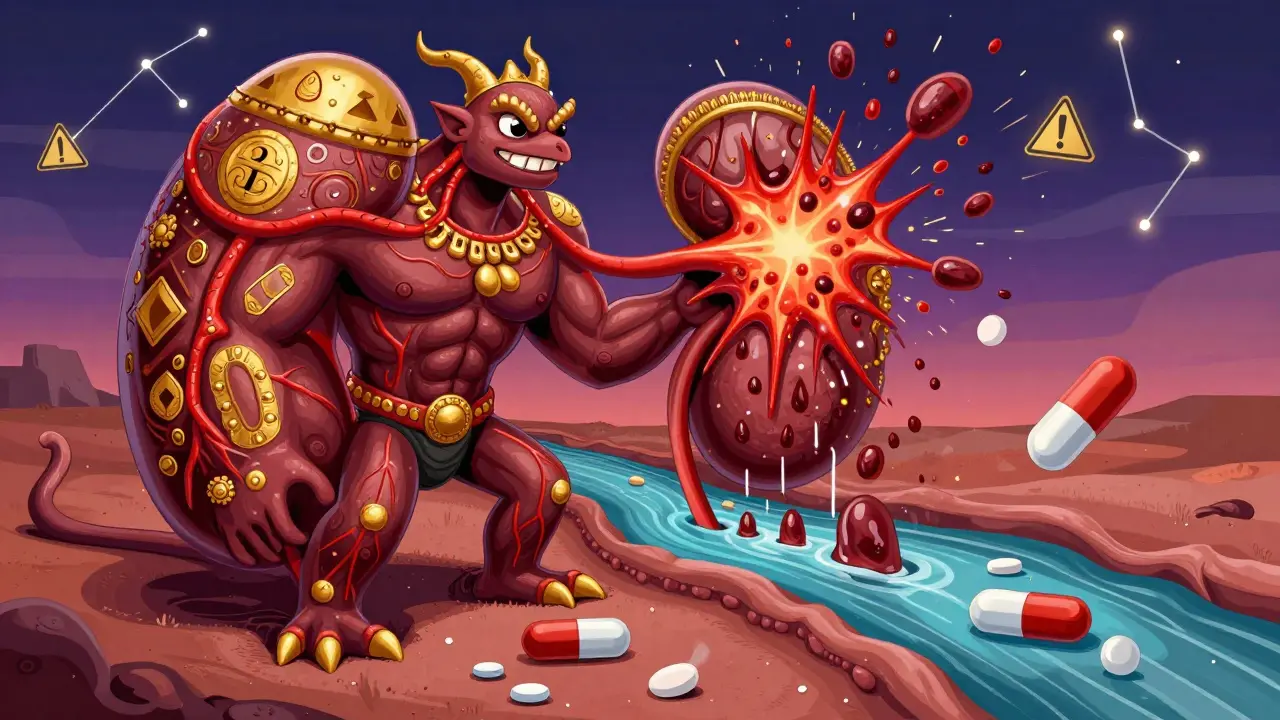
When you take a statin for cholesterol or an antibiotic for an infection, you expect relief-not a life-threatening muscle breakdown. But when certain medications mix, they can trigger rhabdomyolysis, a condition where muscle cells explode, dumping toxic proteins into your blood. It’s not rare. Every year in the U.S., over 27,000 people end up in the hospital because of it, and nearly two-thirds of those cases come from drug interactions you might never see coming.
What Exactly Is Rhabdomyolysis?
Rhabdomyolysis happens when your skeletal muscles start to die, leaking their contents-especially creatine kinase (CK) and myoglobin-into your bloodstream. Myoglobin is the protein that gives muscle its red color. When it floods your kidneys, it clogs the tiny filters, leading to kidney failure. In severe cases, you’ll need dialysis. About half of all patients with rhabdomyolysis develop kidney damage, and 5% to 15% of those cases end in death.The classic signs-muscle pain, weakness, and dark urine-are only present in about half the cases. Many people don’t realize anything’s wrong until they’re vomiting, confused, or not peeing at all. That’s why it’s often missed until it’s too late.
Statins Are the Biggest Culprit
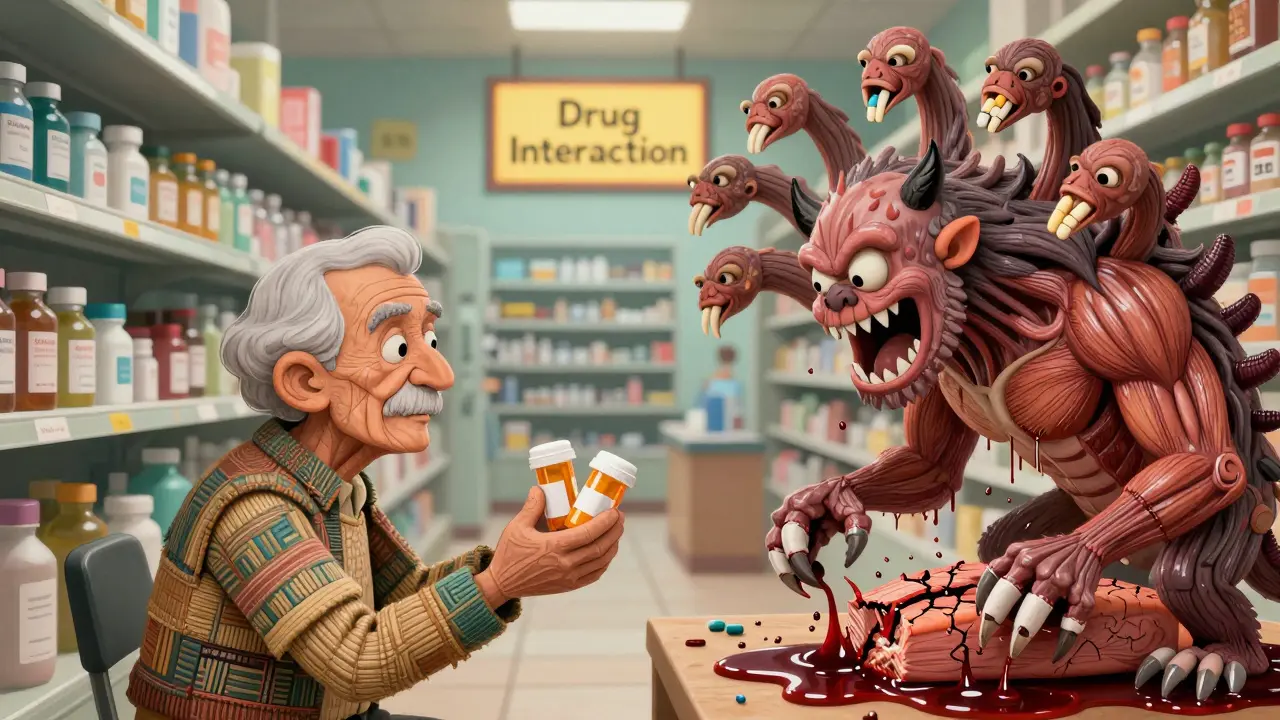
Statins like atorvastatin (Lipitor) and simvastatin (Zocor) are the most common trigger, responsible for 60% of all medication-induced rhabdomyolysis cases. But here’s the catch: most of the time, it’s not the statin alone. It’s what you take with it.Simvastatin combined with gemfibrozil (a cholesterol drug) increases your risk by 15 to 20 times. That’s not a small bump-it’s a cliff. Even more dangerous? Simvastatin with erythromycin (an antibiotic) or itraconazole (an antifungal). These drugs block the same liver enzyme (CYP3A4) that breaks down simvastatin. When that enzyme is shut down, simvastatin builds up to toxic levels in your muscles.
One case from the NIH showed a patient’s CK level-normally under 200 U/L-spiked to over 20,000 U/L within three days after adding erlotinib (a cancer drug) to his simvastatin. That’s 100 times the normal level. He needed dialysis. His doctor didn’t know the two drugs could interact.
Other Dangerous Drug Mixes You Might Not Know About
It’s not just statins. Many common medications can cause muscle breakdown when mixed:- Colchicine + clarithromycin: Used together for gout and infections, this combo increases rhabdomyolysis risk by 14 times. The European Medicines Agency issued a warning in 2021 after reviewing over 1,200 cases.
- Zidovudine (Retrovir): An HIV drug that causes muscle damage in nearly 12% of patients on long-term therapy.
- Leflunomide: A rheumatoid arthritis drug with a half-life of two weeks. When it causes rhabdomyolysis, CK levels can soar past 50,000 U/L. Plasma exchange is often needed because the drug lingers so long.
- Propofol: An IV anesthetic used in ICUs. When given for more than 48 hours, it can cause mitochondrial failure in muscle cells, leading to a 68% death rate if rhabdomyolysis develops.
These aren’t edge cases. They’re documented in peer-reviewed journals and FDA reports. Yet, many doctors still don’t screen for them.
Who’s Most at Risk?
Some people are far more likely to develop this condition:- People over 65: Their kidneys don’t clear drugs as well, and their muscles are more fragile. Risk is 3.2 times higher.
- Women: They experience 1.7 times more cases than men, possibly due to differences in muscle mass and drug metabolism.
- People with kidney disease: If your eGFR is below 60, your risk jumps 4.5 times. Your body can’t flush out the toxins.
- People taking five or more medications: Polypharmacy is the silent killer here. A 2022 JAMA study found these patients are 17 times more likely to develop rhabdomyolysis.
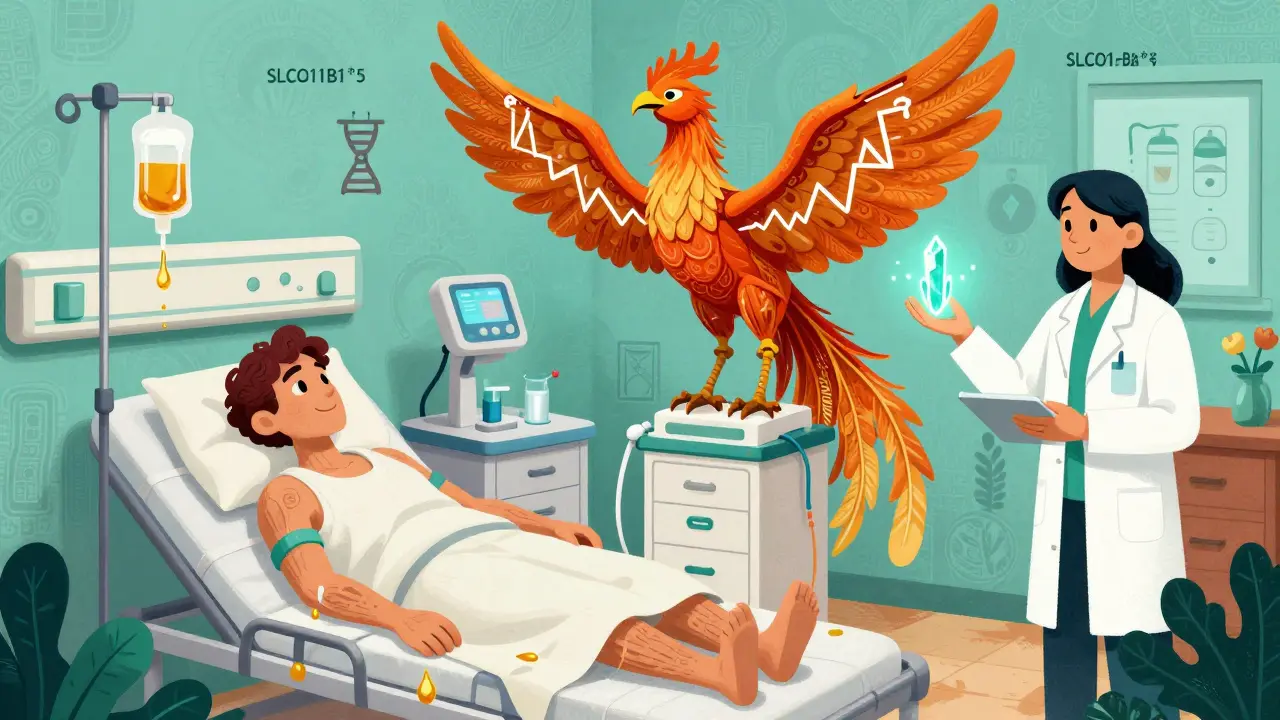
And it’s not just age or health. Genetics play a role too. A specific gene variant called SLCO1B1*5 makes it harder for your body to process simvastatin. People with this variant have a 4.5 times higher risk of muscle damage-even at standard doses.
How It Starts: The Timeline
Rhabdomyolysis doesn’t happen overnight. Most cases show up within 30 days of starting a new drug or changing a dose. Statin-related cases typically appear around 28 days in. That’s why so many people think, “It’s been a month-I’m fine.” But the damage is already building.One Reddit user wrote: “I added clarithromycin to my colchicine for gout. Two days later, my urine looked like cola. My CK was 28,500. I didn’t even know that was possible.”
Another: “My oncologist didn’t warn me about the simvastatin-erlotinib mix. My CK hit 42,000. I spent three days on dialysis.”
These aren’t outliers. They’re textbook.
How Doctors Diagnose It
There’s no single test, but doctors look for three things:- CK levels above 1,000 U/L (five times the normal upper limit). Severe cases often exceed 5,000 or even 100,000 U/L.
- Dark, tea- or cola-colored urine-a sign of myoglobin in the kidneys.
- Symptoms matching the timeline-recent drug changes, muscle pain, weakness.
CK levels rise within 12 hours of muscle damage and peak in 24 to 72 hours. If your CK is over 5,000 U/L, you’re in the danger zone. Most hospitals will start aggressive IV fluids right away.
What Happens in the Hospital
Treatment is simple in theory, hard in practice:- Stop the offending drug immediately. No exceptions.
- IV fluids-lots of them. The Cleveland Clinic’s protocol: 3 liters in the first 6 hours, then 1.5 liters per hour. Goal: urine output of 200-300 mL per hour.
- Alkalinize the urine. Sodium bicarbonate is added to keep urine pH above 6.5. This prevents myoglobin from clumping in the kidneys.
- Monitor electrolytes. Potassium can spike dangerously high (over 5.5 mEq/L), and calcium can crash. Both can cause heart rhythm problems.
- Watch for compartment syndrome. Swelling in muscles can cut off blood flow. If it happens, you need emergency surgery.
Some patients need dialysis. Others need plasma exchange, especially if they’re on leflunomide. Recovery takes weeks. In non-kidney failure cases, muscle strength returns in about 12 weeks. If you needed dialysis? It can take over 28 weeks-and you might never fully recover.
Why This Keeps Happening
Doctors aren’t ignoring the risks. But the system is broken.A 2022 study in the American Family Physician journal found that 92% of patients who developed rhabdomyolysis from drug interactions had their early muscle symptoms dismissed as “just soreness” or “getting older.”
Pharmacies don’t always flag interactions. Electronic health records miss cross-references. Patients don’t know to mention every pill they’re taking-including over-the-counter ones like turmeric or fish oil, which can also affect liver enzymes.
The FDA added black box warnings to statins in 2012. Sales dropped 4.7%. But adherence stayed high-82% of people kept taking them because the heart benefits are real. The problem isn’t statins. It’s the lack of awareness around what they’re mixed with.
What You Can Do
If you’re on any of these medications, here’s what matters:- Know your meds. Write down every pill, supplement, and OTC drug you take. Include dosages and why you take them.
- Ask your pharmacist. Not your doctor. Ask the pharmacist: “Is there any risk of muscle damage if I take this with my other meds?”
- Watch for warning signs. Unexplained muscle pain, weakness, or dark urine? Don’t wait. Go to urgent care. Get a CK test.
- Get tested before starting new drugs. If you’re about to start an antibiotic, antifungal, or cancer drug, ask if your statin needs to be paused.
- Don’t ignore “minor” symptoms. Muscle soreness after a new workout? Maybe. Muscle soreness after starting a new pill? That’s a red flag.
There’s no magic pill to prevent this. But awareness saves lives. You’re the only one who knows what you’re taking. You’re the only one who can speak up.
What’s Being Done
Researchers are working on solutions:- The NIH is funding a $2.4 million project to build real-time drug interaction alerts for doctors.
- The European Renal Association is testing drugs that protect muscle mitochondria during statin therapy.
- EMA and FDA now require statin labels to clearly list contraindications with CYP3A4 inhibitors.
But these changes are slow. The data is there. The warnings are written. The problem is execution.
Recovery and Long-Term Impact
Even if you survive, you might not bounce back fully. A 10-year Mayo Clinic study found that 44% of survivors still had muscle weakness six months later. For those who needed dialysis, full recovery took nearly seven months longer than those who didn’t.And the risk doesn’t go away. Once you’ve had rhabdomyolysis from a drug, you’re far more likely to get it again-even with a different medication. That’s why many doctors avoid prescribing statins altogether after one episode.
It’s not just about avoiding one bad combo. It’s about understanding that your body is a system. One drug can change how another behaves. And when muscles start breaking down, your kidneys are the next to fall.
Can rhabdomyolysis happen from just one medication, or only from interactions?
Rhabdomyolysis can happen from a single medication, especially high-dose statins, colchicine, or propofol. But most severe cases-especially those leading to kidney failure-are caused by drug interactions. About 70% of medication-induced cases involve two or more drugs that affect the same liver enzyme, causing one to build up to toxic levels.
Is it safe to take statins if I’m on an antibiotic?
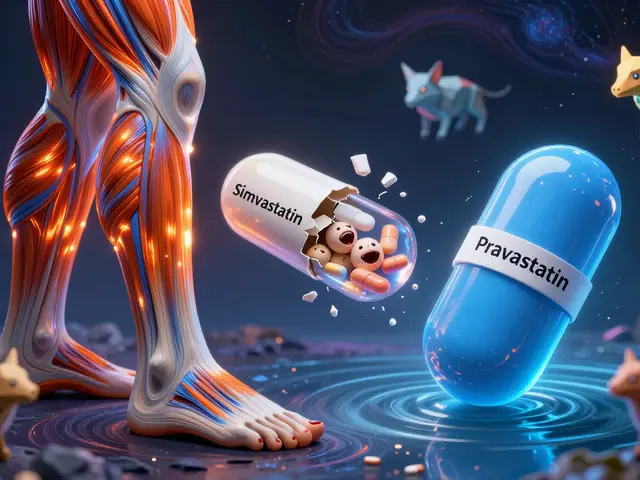
It depends on the antibiotic. Macrolides like erythromycin and clarithromycin, and antifungals like itraconazole and ketoconazole, can dangerously increase statin levels. Avoid simvastatin and lovastatin entirely with these. Atorvastatin is safer but still risky. Rosuvastatin and pravastatin are better choices because they’re not metabolized by the same liver enzyme. Always check with your pharmacist before combining them.
How do I know if my dark urine is from rhabdomyolysis or just dehydration?
Dehydration makes urine dark yellow or amber. Rhabdomyolysis makes it tea-colored, cola-colored, or even reddish-brown. If you’ve recently started a new medication or feel unusually weak or sore, don’t assume it’s just dehydration. Get a blood test for creatine kinase (CK). A level above 1,000 U/L confirms muscle breakdown. Waiting can cost you your kidneys.
Can supplements cause rhabdomyolysis?
Yes. High doses of niacin (vitamin B3), creatine, and even green tea extract have been linked to cases, especially when combined with statins. Herbal supplements like red yeast rice contain natural statins and can cause the same risks as prescription ones. Many people don’t realize these are drugs too. Always tell your doctor about every supplement you take.
If I’ve had rhabdomyolysis once, can I ever take statins again?
Some doctors will avoid statins entirely after one episode. Others may try a very low dose of pravastatin or rosuvastatin-drugs less likely to interact with liver enzymes. But you’ll need close monitoring, regular CK tests, and you’ll have to avoid all CYP3A4 inhibitors. The risk of recurrence is high. Many patients choose to manage cholesterol with diet, exercise, and non-statin drugs like ezetimibe or PCSK9 inhibitors instead.
13 Comments
Write a comment