
After a colonoscopy finds and removes polyps, many people assume they’re in the clear-until they get a letter saying they need another procedure in just a few years. Why? Because not all polyps are the same. Some are harmless, others are warning signs. And getting the next colonoscopy at the right time can mean the difference between catching cancer early-or missing it entirely.
Not All Polyps Are Created Equal
The key to knowing when to return for your next colonoscopy lies in three things: size, number, and type. A 5-millimeter adenoma is very different from a 15-millimeter one. A single polyp means something else than five. And histology-what the tissue looks like under a microscope-matters more than most patients realize.Adenomas are the most common precancerous polyps. If you have one or two that are 10 millimeters or smaller, current U.S. guidelines say you can wait 7 to 10 years for your next colonoscopy. That’s a big change from just a few years ago, when the standard was 5 years. Studies now show that people with these small, low-risk adenomas have nearly the same cancer risk as those with completely normal colonoscopies.
But if you have three or four adenomas under 10 mm, the clock resets faster. You’ll need another colonoscopy in 3 to 5 years. And if you have five or more polyps-no matter their size-that’s a red flag. You’ll need to come back in just 3 years.
High-Risk Features Change Everything
Size isn’t the only factor. Some polyps look more dangerous under the microscope. If your pathologist finds villous histology, high-grade dysplasia, or a traditional serrated adenoma, your risk jumps. Even if the polyp is only 8 mm, these features mean you need a follow-up in 3 years.Sessile serrated lesions (SSLs) are another category that trips up even some doctors. These polyps are flat, hard to spot, and can turn into cancer silently. If you have one or two SSLs under 10 mm, you’re in the 5- to 10-year window. Three or four? 3 to 5 years. Five or more? Back in 3 years. And if the polyp was removed in pieces (piecemeal resection), especially if it was over 20 mm, you need a repeat colonoscopy in 6 months to make sure nothing was left behind.
Hyperplastic Polyps: Not Always Benign
Many people hear "hyperplastic polyp" and think, "No problem." But that’s not always true. Small hyperplastic polyps (under 5 mm) in the rectum are almost always harmless. But if you have one that’s 10 mm or larger-or if your doctor can’t be sure it’s not an SSL-you need to be cautious. In those cases, guidelines recommend a 3- to 5-year follow-up. If your bowel prep was poor or the polyp was hard to remove completely, lean toward the 3-year mark.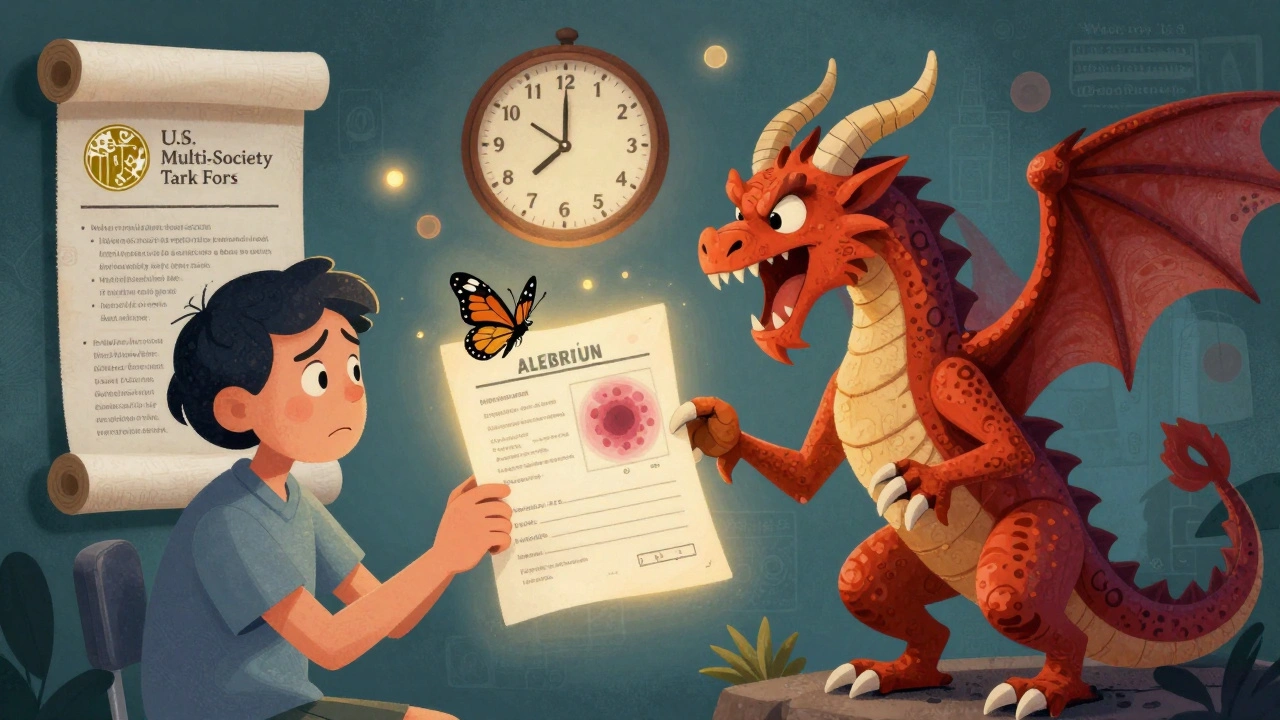
What About Serrated Polyposis Syndrome?
This rare condition-where someone has dozens of serrated polyps scattered throughout the colon-is a different ballgame. People with this syndrome have a very high risk of colon cancer. If you’ve been diagnosed, you’ll need annual colonoscopies. Some guidelines say you can stretch that to every 2 years after a few clean exams, but only if no polyp larger than 10 mm is found. Still, most doctors err on the side of caution and stick with yearly checks until age 75.Why Do Doctors Keep Recommending 5 Years?
Here’s the frustrating part: even though the official guidelines changed in 2020, many doctors still tell patients to come back in 5 years. A 2020 study at a Veterans Affairs hospital found that 81% of gastroenterologists who knew the updated rules still recommended 5-year intervals for low-risk adenomas. Why? Fear.Doctors worry about lawsuits if they miss something. Patients ask, "Why wait so long?" And insurance doesn’t always make it easy to justify longer intervals. Some doctors use 7 years as a middle ground-safe enough, but not too risky. But if your doctor says "5 years," ask why. Show them the 2020 US Multi-Society Task Force guidelines. You might be saving yourself an unnecessary procedure.
International Differences: What’s Right in Europe?
Guidelines aren’t the same everywhere. In the U.S., 7-10 years is standard for low-risk adenomas. In the UK and parts of Europe, some experts say 10-12 years is fine for tiny polyps. European guidelines also give more flexibility-like a 3- to 6-month window after removing a large polyp in pieces, instead of a fixed 6 months. The U.S. system is more rigid, with clear thresholds. Europe leans on morphology and resection quality. Neither is wrong-but if you’re traveling or getting care abroad, knowing the difference helps.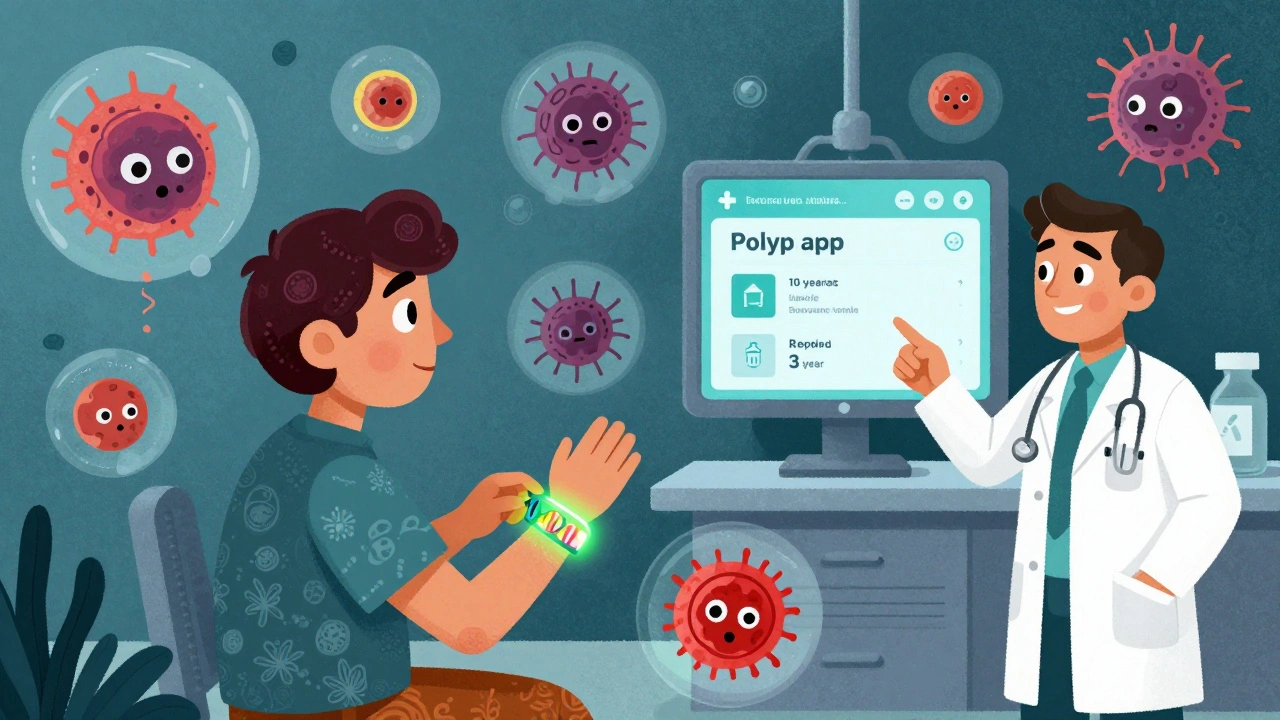
Technology Is Helping-But Not Everywhere
Tools like Polyp.app, developed by gastroenterologists at Massachusetts General Hospital, now help doctors input polyp details and get an instant recommendation. As of 2023, over 12,000 clinicians use it. EHR systems like Epic and Cerner are starting to auto-suggest follow-up dates based on what’s documented during the procedure. But adoption is uneven. In rural clinics or older practices, many doctors still write follow-up notes by hand-and make mistakes.A 2022 survey found that only 37% of U.S. gastroenterologists could correctly identify all the risk categories in the 2020 guidelines. And SSL management? Only 28.5% got it right. That’s not just a knowledge gap-it’s a public health risk.
What If You Can’t Afford Another Colonoscopy?
Colonoscopy isn’t cheap. In the U.S., it can cost $1,000 to $3,000 without insurance. But skipping a recommended follow-up because of cost is dangerous. The good news: Medicare and most private insurers cover surveillance colonoscopies under preventive benefits. If you’re denied coverage, ask for a letter of medical necessity from your doctor. The 2020 guidelines are officially recognized by CMS. If your insurer refuses, file an appeal. You’re not asking for a luxury-you’re asking for cancer prevention.The Future: Personalized Surveillance
The next big shift won’t be about counting polyps. It’ll be about molecular markers. Right now, researchers are testing DNA methylation patterns, stool-based biomarkers, and blood tests to predict who’s truly at high risk. Trials like NCT04567821 are already showing promise. In the next 5 years, your follow-up schedule might be based on your genetic profile, not just what the endoscopist saw.For now, though, stick to the facts: know your polyp type, size, and number. Ask for a copy of your pathology report. Don’t let vague advice like "come back in 5 years" go unchallenged. Use the 2020 USMSTF guidelines as your reference. And if you’re unsure, ask your doctor: "Based on my specific findings, what’s my exact risk category?"
Colon cancer is one of the most preventable cancers-if you get the right follow-up at the right time. Too early? You’re spending money and time on an unnecessary procedure. Too late? You’re gambling with your life. The science is clear. Now it’s up to you to make sure your doctor follows it.
How long should I wait for my next colonoscopy after having one small adenoma removed?
If you had one or two adenomas that were 10 millimeters or smaller and had no high-risk features like villous histology or high-grade dysplasia, you should wait 7 to 10 years for your next colonoscopy. This is based on the 2020 US Multi-Society Task Force guidelines, which found that cancer risk for these patients is nearly the same as for people with normal colonoscopies.
What if I had a serrated polyp instead of an adenoma?
Sessile serrated lesions (SSLs) require different timing. If you had one or two SSLs under 10 mm, wait 5 to 10 years. Three or four? Return in 3 to 5 years. Five or more? You need another colonoscopy in 3 years. If the polyp was large (over 10 mm) or removed in pieces, your doctor may recommend a follow-up in 6 months to ensure complete removal.
Why does my doctor want me back in 3 years when I only had two polyps?
It’s likely because one or both polyps had high-risk features-like being larger than 10 mm, having villous components, or showing high-grade dysplasia. Or maybe you had three or four polyps total, even if they were small. Ask for your pathology report. The number alone doesn’t tell the full story. Histology and size matter more.
Is it safe to wait 10 years if I had a small adenoma?
Yes, it’s safe. Multiple large studies show that patients with 1-2 small adenomas have a 98.7% to 99.3% chance of remaining cancer-free over 10 years-almost identical to people with no polyps. The 2020 guidelines extended the interval to reduce unnecessary procedures, not because risk disappeared. The key is having a high-quality colonoscopy the first time.
What happens if I get a colonoscopy too early?
Getting a colonoscopy too soon doesn’t harm you physically, but it wastes resources, increases costs, and exposes you to unnecessary risks like bowel perforation or sedation side effects. It also crowds the system, making it harder for people who truly need it to get timely care. Stick to your recommended interval unless you develop new symptoms like bleeding or changes in bowel habits.
Can I skip my follow-up colonoscopy if I feel fine?
No. Most precancerous polyps and early-stage colon cancers don’t cause symptoms. By the time you feel something, it may already be advanced. Surveillance colonoscopies are designed to catch problems before they become dangerous. Feeling fine doesn’t mean you’re risk-free-it means your colon is still quiet.
Do I need a colonoscopy if I have hyperplastic polyps?
Small hyperplastic polyps (under 5 mm) in the rectum usually don’t require follow-up beyond routine screening. But if you have a hyperplastic polyp over 10 mm, or if your doctor suspects it might be a serrated lesion, you need a follow-up in 3 to 5 years. Always confirm the pathology report-some hyperplastic polyps are misclassified SSLs.
How do I know if my colonoscopy was done well enough?
Ask your doctor for the adenoma detection rate (ADR) of the endoscopist-ideally above 25% for men and 20% for women. Also check if your bowel prep was rated as "excellent" or "good." Poor prep increases the chance polyps were missed. If your prep was poor or the doctor couldn’t see the entire colon, you may need a repeat sooner than the guidelines suggest.

Interesting read. I had a small adenoma removed last year and was told to come back in 5 years. Found out later it should’ve been 7–10. Glad I checked the guidelines. Always good to ask.
Doctors are so scared of lawsuits they’ll schedule colonoscopies for people who don’t need them just to cover their asses
The real issue isn’t the guidelines-it’s the gap between what’s known and what’s practiced. Studies show 7–10 years is safe for low-risk cases but most clinicians still default to 5. It’s not ignorance-it’s institutional inertia. Fear of liability overrides evidence. We need better EHR integration and mandatory continuing education for gastroenterologists. The science is settled. The system isn’t.
It’s fascinating how much of medicine is still rooted in tradition rather than data. I remember when we were told to do annual colonoscopies for anyone with a polyp-now we know that’s wildly overkill for small adenomas. But changing practice takes time. Patients are conditioned to believe more frequent = better care, and doctors are conditioned to avoid any risk, even if the risk is just an unnecessary procedure. The real challenge isn’t the science-it’s the culture. We need to re-educate both clinicians and patients that prevention isn’t about doing more tests-it’s about doing the right test at the right time. And that requires trust in evidence, not fear of lawsuits.
So if you’re low risk, wait 7–10 years. Sounds simple enough. Just don’t forget to ask for your pathology report!
Had a SSL removed last year. Doc said 5 yrs. Found out later it was wrong. UK says 10 if its small. Feels like a lottery. Also my prep was bad but they still said 5. I’m just waiting for the next one now…
Most people don’t even know what an adenoma is, let alone villous histology. If you’re not reading your pathology report, you’re not taking your health seriously. And if your doctor doesn’t mention these terms, you need a new one.
Let me be very clear: if you have one or two small adenomas, you do not need a colonoscopy in five years. The 2020 US Multi-Society Task Force guidelines are unequivocal: 7 to 10 years. If your doctor says otherwise, ask them to show you the evidence. If they can’t, get a second opinion. This isn’t opinion-it’s data-driven medicine. And if your doctor is still using outdated protocols, they’re not just being cautious-they’re being negligent. You deserve better.
I’ve been waiting for someone to say this. The system is broken. I had a 12mm SSL removed, and my insurance denied the 6-month follow-up because it was "not medically necessary"-even though the endoscopist documented piecemeal resection. I had to appeal, submit the guidelines, and get my doctor to write a 3-page letter. And still, the rep said, "We’ve never seen this before." It’s not about the science anymore. It’s about bureaucracy. And the people who suffer? The ones who can’t fight back.