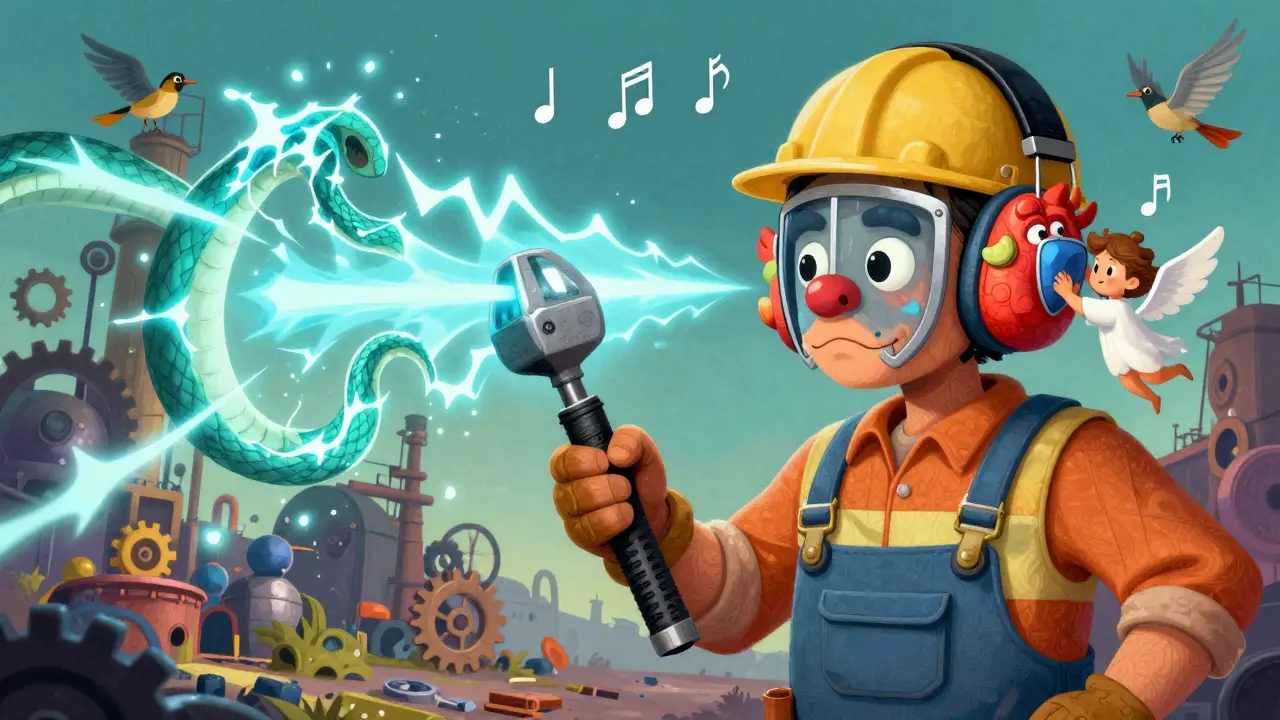
Every year, millions of people lose their hearing-not from aging, not from illness, but from something completely preventable: noise. Whether you’re working on a construction site, operating a jackhammer, or standing in front of a speaker at a concert, loud sounds are silently damaging your ears. And most people don’t even realize it until it’s too late.
What Counts as Dangerous Noise?
Noise isn’t just about volume-it’s about time and intensity. The human ear can handle 85 decibels (dBA) for up to eight hours without damage. That’s about the level of heavy city traffic or a lawnmower. But here’s the catch: every time the noise goes up by 3 decibels, your safe exposure time cuts in half. So at 88 dBA, you’ve got only four hours. At 91 dBA, it’s two hours. At 100 dBA-like a chainsaw or a motorcycle-you’ve got just 15 minutes before damage starts. The National Institute for Occupational Safety and Health (NIOSH) says 85 dBA is the threshold where hearing loss risk becomes real. The Occupational Safety and Health Administration (OSHA), on the other hand, allows up to 90 dBA for eight hours. That 5-decibel gap isn’t just paperwork-it’s the difference between a 25% chance of hearing loss over a career and under 8%. NIOSH’s standard is based on decades of research showing that even moderate noise, over time, causes permanent damage. OSHA’s rules are legal limits. NIOSH’s are health limits.How Noise Damages Your Ears
Your inner ear has tiny hair cells that convert sound waves into electrical signals your brain understands. These cells don’t grow back. Once they’re damaged by loud noise, the hearing loss is permanent. It doesn’t happen all at once. It sneaks up on you. You might not notice until you’re struggling to hear conversations in a crowded room, or your friends keep telling you to turn down the TV. Studies show that workers exposed to 85-90 dBA for 20 years show clear, measurable hearing loss-especially in the 3,000 to 6,000 Hz range, where speech clarity lives. That’s why people often say, “I can hear you, I just can’t understand you.” And it’s not just factory workers. Musicians, bartenders, airport ground crews, and even gym instructors are at risk. A 2022 survey found that 63% of professional musicians have some degree of hearing loss. At a rock concert, sound levels can hit 110-120 dBA. That’s like standing next to a jet engine. Even a two-hour show can cause temporary hearing loss, ringing in the ears, or muffled hearing. For some, those symptoms never fully go away.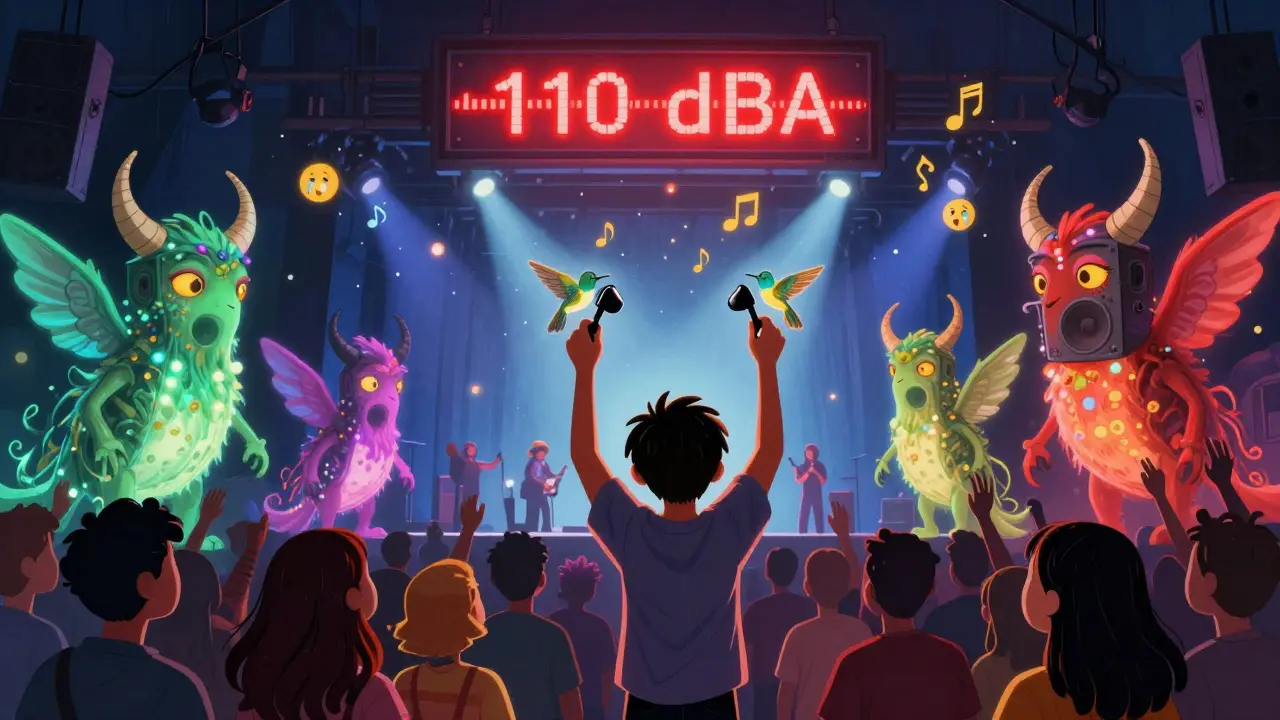
Workplace Rules: What Employers Must Do
If you work in a noisy environment, your employer is required by law to protect you-but only if they follow the rules. OSHA requires a hearing conservation program once noise hits 85 dBA over eight hours. That means:- Free hearing tests (audiograms) when you start and every year after
- Training on how noise damages hearing
- Access to hearing protection (earplugs or earmuffs)
- Monitoring noise levels with proper equipment
- Eliminate or reduce noise at the source. Buy quieter tools. Replace old machines. Use vibration dampeners.
- Block the noise. Install sound barriers, enclosures, or acoustic panels.
- Limit time. Rotate workers so no one is exposed for too long.
- Protect your ears. Earplugs and earmuffs come last.
Concerts, Festivals, and Personal Audio
You’re not safe just because you’re not at work. Concerts are a major source of preventable hearing loss. The World Health Organization recommends limiting personal audio device use to 40 hours per week at 80 dBA. That’s about half the volume of a typical headphone setting. Most people blast music at 90-100 dBA-sometimes higher. At live events, noise levels often exceed 110 dBA. That’s not just loud-it’s dangerous. Even a few minutes can cause temporary hearing loss. A 2023 study found that 50% of concertgoers experience a temporary threshold shift after a show. That’s your ears’ warning sign. If you leave with ringing ears or muffled hearing, you’ve already damaged your cells. Some venues are starting to change. The Lifehouse Festival gives out free, high-fidelity earplugs-and 75% of attendees take them. Others install sound level displays so you can see the decibels in real time. Quiet zones with background noise under 75 dBA let people rest their ears between sets. Apple and Spotify now have “safe listening” features that alert you when your volume exceeds 85 dBA equivalent. It’s not perfect, but it’s a start.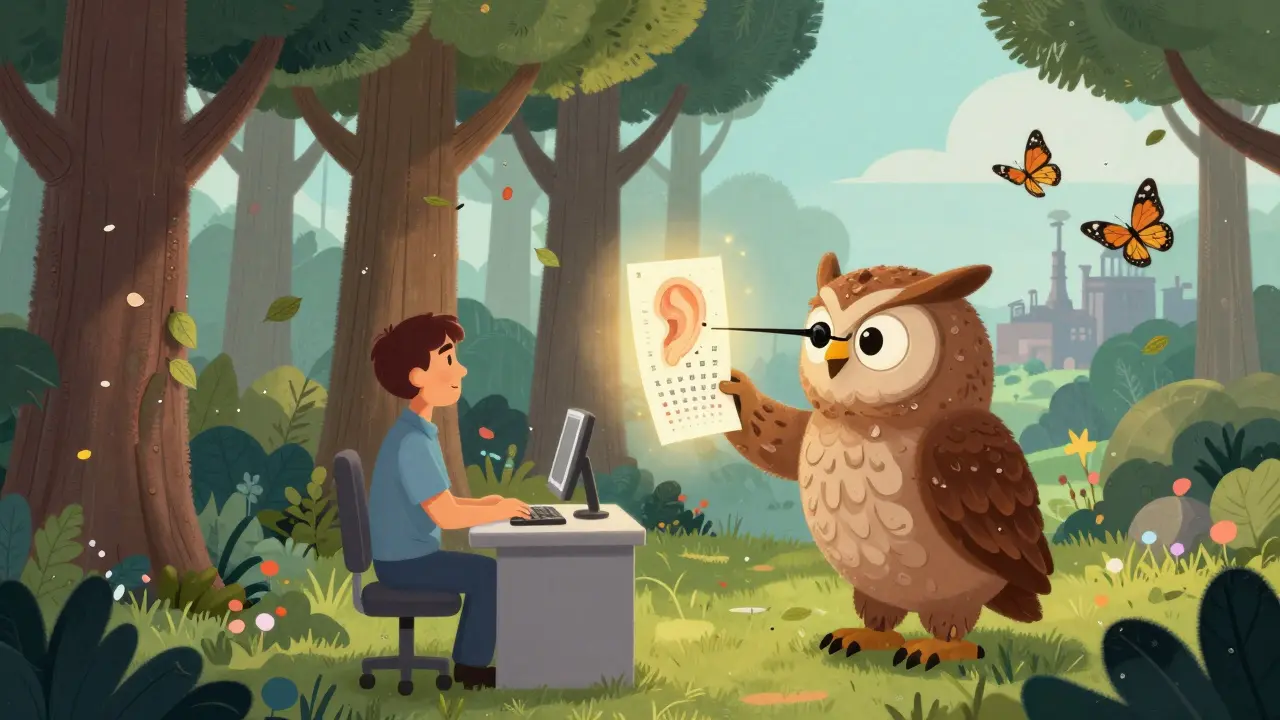
What You Can Do Right Now
You don’t need to wait for your employer or a festival organizer to act. Here’s what you can do today:- Use earplugs at concerts. Don’t wait until you’re in pain. High-fidelity earplugs reduce volume evenly so music still sounds natural. Brands like Etymotic, Loop, and Vibes cost under $30 and last for years.
- Follow the 60/60 rule for headphones. No more than 60% volume for 60 minutes at a time. Take breaks.
- Check your environment. Use a free smartphone app (like NIOSH’s Sound Level Meter) to measure noise around you. If it reads above 85 dBA for more than an hour, protect your ears.
- Get tested. If you’re regularly exposed to loud noise, get a baseline hearing test. Compare it every year. Catching early changes saves your hearing.
- Speak up. If your workplace is loud and no one’s doing anything, ask for a noise assessment. You have rights.
The Bigger Picture: Why This Matters
Hearing loss isn’t just about missing a song or struggling to hear your grandkids. It’s linked to depression, social isolation, cognitive decline, and even dementia. The CDC says 24% of all hearing loss in the U.S. is caused by noise-and nearly all of it is preventable. The economic cost is huge. Workers’ compensation for hearing loss costs over $1 billion a year in the U.S. alone. Manufacturing, construction, and mining account for most claims. But the human cost? That’s harder to measure. It’s the musician who can’t hear her own instrument. The mechanic who can’t hear his coworker call out a warning. The father who misses his child’s first words. The good news? We know how to stop it. The European Union, Australia, and California already use the stricter 85 dBA standard. The European Commission is pushing to extend those rules to concert venues. NIOSH estimates that if every workplace and entertainment venue adopted 85 dBA limits, we could prevent 240,000 cases of hearing loss every year in the U.S. by 2040. This isn’t about being overly cautious. It’s about being smart. Your ears are irreplaceable. Once they’re gone, no pill, no surgery, no hearing aid can bring them back.Is 85 decibels really that loud?
Yes. 85 dBA is about the noise level of heavy city traffic, a lawnmower, or a blender running. It’s not screeching or ear-splitting, but if you’re exposed to it for eight hours a day, five days a week, it will damage your hearing over time. The danger isn’t how loud it sounds-it’s how long you’re exposed.
Can I rely on my phone to measure noise levels?
Yes, with caveats. Apps like NIOSH’s Sound Level Meter are accurate within 2-3 decibels of professional equipment. That’s good enough to tell you if you’re in a risky zone (above 85 dBA). But don’t trust cheap apps from unknown developers-they’re often unreliable. Stick to trusted sources like NIOSH or OSHA-recommended tools.
Are foam earplugs good enough for concerts?
They reduce noise, but they don’t sound right. Foam plugs muffle high frequencies, making music sound dull and distant. For concerts, use high-fidelity earplugs with filters that lower volume evenly across all frequencies. They preserve clarity while protecting your ears. They cost a little more, but they’re worth it if you care about music-and your hearing.
What if my employer won’t provide hearing protection?
If noise exceeds 85 dBA over an 8-hour shift, your employer is legally required to offer a hearing conservation program under OSHA rules. If they’re not doing it, you can file a confidential complaint with OSHA. You have the right to a safe workplace. No one should lose their hearing because their employer ignored the rules.
Can noise-induced hearing loss be reversed?
No. Once the hair cells in your inner ear are damaged, they don’t regenerate. Hearing aids and cochlear implants can help you hear better, but they can’t restore lost hearing. Prevention is the only cure.
How often should I get my hearing checked?
If you’re regularly exposed to noise above 85 dBA, get a baseline test within six months of starting. Then get tested every year. If you’re not exposed but notice ringing, muffled sounds, or trouble hearing in crowds, get tested anyway. Early detection is key.
They're putting tracking chips in earplugs now, I swear. I saw a guy at a concert with those fancy ones and his phone started buzzing like a damn alarm. They're using your hearing loss to sell you more gadgets. Next thing you know, your ears are a data point for Big Audio.
Look, I get the whole 85 dBA thing, but let’s be real-most people don’t even know what a decibel is. I worked in a warehouse for ten years with jackhammers going off next to me, and I never wore earplugs because I thought if I could still hear the guy yelling across the floor, I was fine. Turns out, I wasn’t. My hearing’s shot in the high frequencies now-I can hear birds chirping but not my own daughter’s voice when she says ‘Dad’ from the other room. And yeah, I blame the company for not doing more than handing out foam plugs that looked like they came from a 1998 hardware store. But I also blame myself for thinking I was invincible. The science is clear, but human nature? Not so much.
85 dBA?! That’s a lie!! The government’s been lying about noise for decades!! I’ve measured my chainsaw at 102 dBA, but my neighbor’s Bluetooth speaker? 98 dBA!! And they say it’s safe?? NO!! They’re hiding the truth-sound frequencies are being weaponized to desensitize the population!! I’ve got a prototype earplug that blocks 5G harmonics too!! You think this is about hearing? It’s about control!!
I’ve been thinking a lot about how we treat our bodies like machines that can just keep going. We don’t think about hearing the way we think about sleep or nutrition. But it’s the same thing-you don’t notice the damage until it’s irreversible. I used to blast music while I worked. Now I listen at 50% volume and take breaks. It’s not glamorous, but I can still understand my wife when she talks to me after a long day. Maybe that’s the real metric-not the decibel reading, but whether you still hear the people you love.
Just started using those Etymotic plugs at gigs. Best decision ever. Music still sounds amazing, and I don’t leave with my head ringing. If you’re reading this and you’ve ever walked out of a concert feeling like you’re underwater-do yourself a favor. Buy a pair. Your future self will thank you.
I work in a warehouse and we got new sound-dampening panels installed last year. It’s not perfect, but the noise dropped noticeably. The company didn’t have to do it-they could’ve just kept giving out the same foam plugs. But they did. It made me feel seen. Sometimes the small things matter more than the big rules.
Employers who fail to implement proper hearing conservation programs are not just negligent-they are complicit in the long-term degradation of their employees’ quality of life. The fact that OSHA allows 90 dBA is a moral failure disguised as regulation. If your workplace doesn’t meet NIOSH standards, you have a duty-not just a right-to demand change. Your hearing is not a bargaining chip. It is a biological imperative. And if your employer won’t protect it, then you must become the advocate they refuse to be.
People think they’re being smart by ‘just turning down the music’-but they’re not. You think you’re being careful? You’re just delaying the inevitable. The damage is already done. You’ve been poisoning your ears since you were 15 with your iPod. Now you’re mad because your hearing’s gone? Don’t blame the concert. Blame yourself. And stop pretending you’re not part of the problem.
I used to think earplugs made me look like a nerd. Then I went to a festival, popped in my Vibes, and realized-holy hell, I could actually hear the lyrics. Not muffled, not distorted, just… clear. Like the music was breathing again. I’ve bought five pairs since then. One for the gym, one for the bike commute, one for the pub, one for travel, and one as a spare. My mates laugh. But when they hear me say ‘I can still hear you’ after the bar’s been pumping dubstep for two hours? They shut up. And then they ask where I got them.