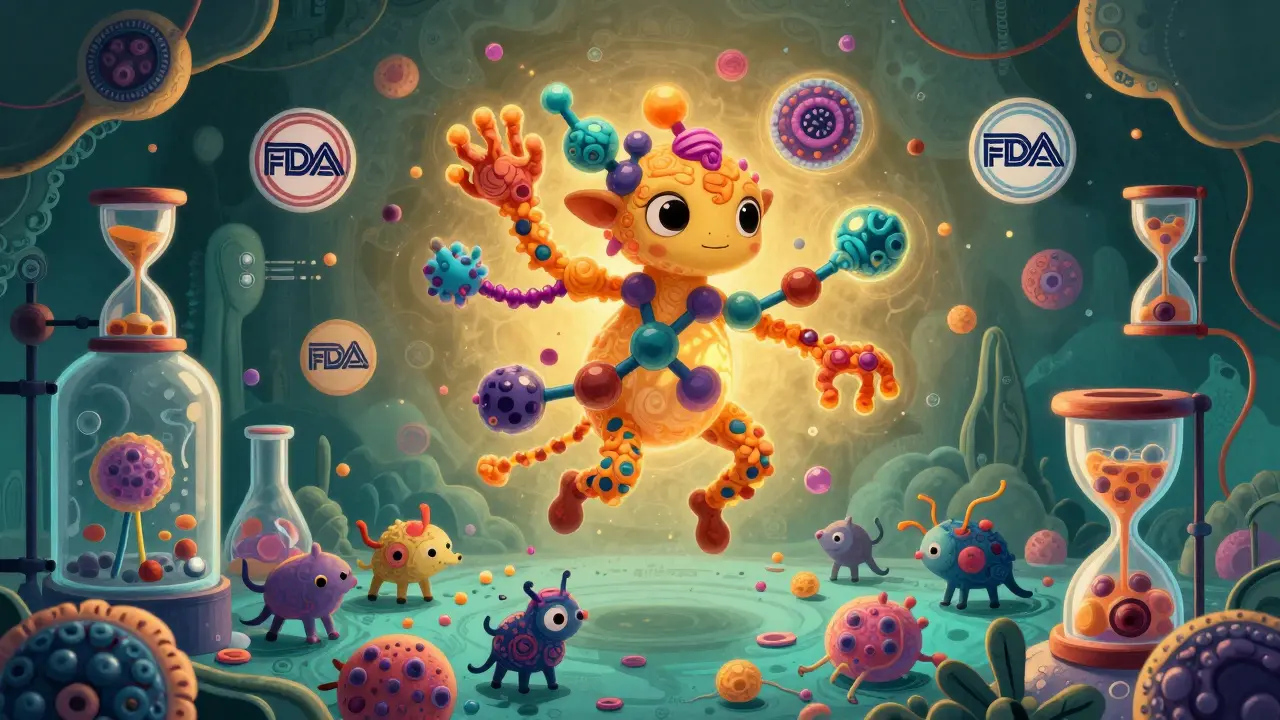
When you take a biologic drug - whether it’s the original brand or a biosimilar - you might assume every pill or injection is exactly the same. But that’s not true. Unlike a simple aspirin tablet, biologics are made from living cells. And because they come from biology, not chemistry, each batch - or lot - is naturally different. Not in a dangerous way, but in subtle, measurable ways that scientists have learned to manage. This is called lot-to-lot variability, and it’s not a flaw. It’s a fact of life for biologic medicines.
Why biologics aren’t like generics
Small-molecule drugs, like metformin or lisinopril, are made by mixing chemicals in a lab. Every tablet has the same molecules, in the same arrangement, down to the last atom. That’s why a generic version can be called an “exact copy.” Biologics? They’re different. They’re large, complex proteins - antibodies, hormones, enzymes - made inside living cells, usually in bioreactors filled with engineered yeast or mammalian cells. These cells don’t follow a blueprint like a machine. They respond to tiny changes in temperature, nutrients, pH, and even the air around them. The result? Each batch produces millions of slightly different versions of the same protein. The U.S. Food and Drug Administration (FDA) says it plainly: “Biosimilars are not generics.” A biosimilar isn’t meant to be identical. It’s meant to be highly similar - with no clinically meaningful differences in safety or effectiveness. That’s why the approval process for biosimilars isn’t just a paperwork shortcut like it is for generics. It requires years of testing: thousands of analytical comparisons, functional studies, and often clinical trials to prove that even with natural variation, the biosimilar performs just like the original.What causes these differences?
The variations aren’t random mistakes. They’re predictable biological outcomes. The most common changes happen during what’s called post-translational modification. After the protein is made by the cell, extra pieces get added - like sugar molecules (glycosylation), phosphate groups, or changes to amino acids. These tiny modifications can affect how the protein folds, how stable it is, or how well it binds to its target in the body. Think of it like knitting the same sweater, but using slightly different yarn, needle tension, or even the knitter’s mood. The final product looks the same, but the texture, density, or drape might vary a little. For biologics, those differences are measured in parts per million. A single lot might contain over 10 million different versions of the same antibody - all slightly altered, but all still doing the same job. The FDA requires manufacturers to track these variations with extreme precision. Tools like mass spectrometry, chromatography, and advanced bioassays can detect differences smaller than a single sugar molecule. If a new lot shows a shift in glycosylation pattern beyond a pre-approved range, the batch is rejected. This isn’t about perfection - it’s about staying within a proven safety zone.How regulators ensure safety despite variability
The FDA doesn’t expect every lot to be identical. They expect manufacturers to control the pattern and degree of variation. Think of it like setting boundaries on a dance floor - you don’t need everyone to move in perfect sync, but you do need to make sure no one steps out of bounds. For a biosimilar to get approved, the manufacturer must show:- Their product’s range of variation overlaps with the reference product’s range
- The types of modifications are the same (e.g., similar glycosylation profiles)
- There’s no difference in how the drug works in the body (functional activity)
- Clinical studies confirm safety and effectiveness are equivalent
What this means for labs and testing
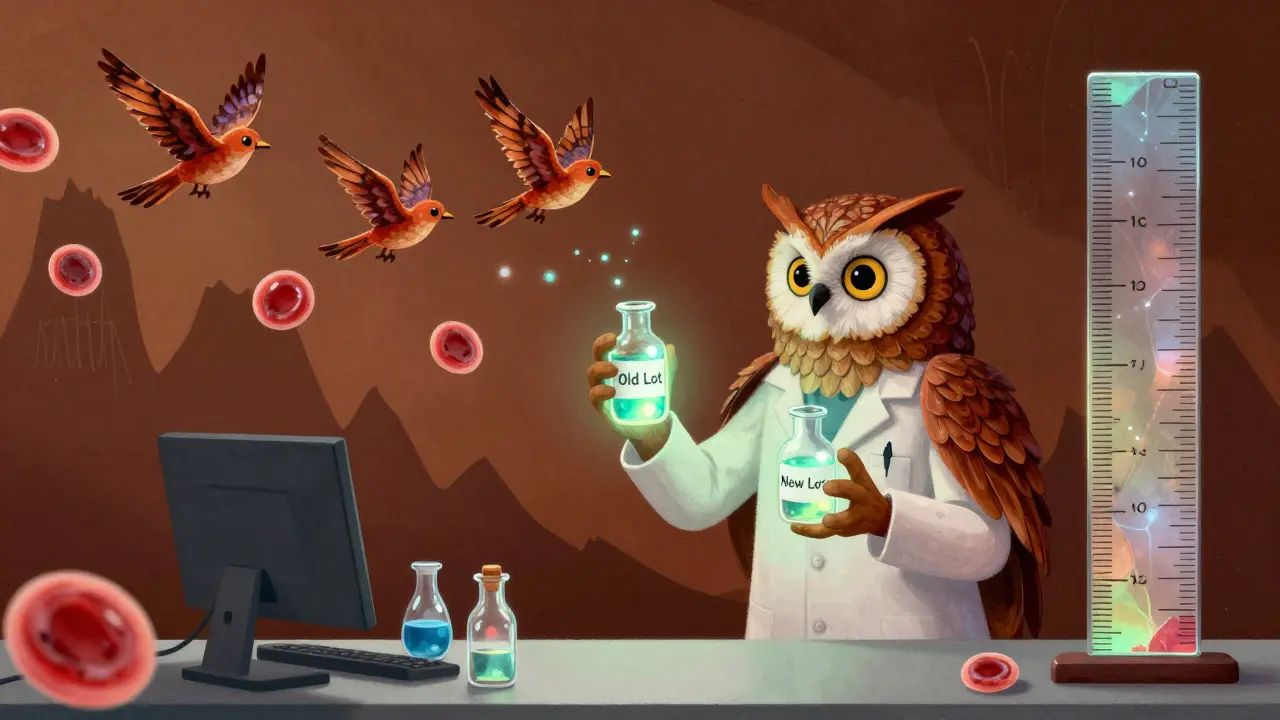
Lot-to-lot variability isn’t just a problem for drugmakers. It’s a daily challenge for clinical labs. When a lab switches to a new reagent lot for a blood test - say, for HbA1c (a diabetes marker) - they can’t just assume the results will be the same. A 2022 survey found that 78% of lab directors consider reagent lot changes a “significant challenge.” Why? Because quality control samples don’t always behave like real patient samples. There’s a phenomenon called “lack of commutability.” That means a control sample might show no change between lots, but patient results shift by 0.5% or more - enough to change treatment decisions. One documented case showed patients’ HbA1c results jumped after a reagent lot change, even though the lab’s controls looked fine. To prevent this, labs use strict verification protocols:- Test at least 20 patient samples with duplicate measurements
- Compare results from the old and new lot against predefined performance limits
- Use moving averages to track long-term trends in patient data
Why this matters for patients
If you’re taking a biologic for rheumatoid arthritis, Crohn’s disease, or cancer, you might be prescribed a biosimilar to save money. That’s a good thing. Biosimilars cost 15-35% less than the original biologic, and they’re just as safe and effective. But you might wonder: “What if my next refill is a different lot? Will it work the same?” The answer is yes - as long as it’s been approved. The FDA and manufacturers have built layers of safeguards to make sure your treatment stays consistent. Even if you switch from the brand to a biosimilar - or between two biosimilars - your body won’t react differently, because the variation is controlled and monitored. For patients on interchangeable biosimilars, the switch can happen at the pharmacy without a new prescription. That’s a big win for access and affordability. Still, if you’ve ever noticed a change in how you feel after a refill - even a small one - talk to your doctor. While rare, individual responses can vary. But that’s not because the drug changed. It’s because your body is complex, and medicine isn’t one-size-fits-all.
The future: More complexity, better tools
Biologics are getting even more complex. New therapies like antibody-drug conjugates (ADCs) and cell and gene therapies involve multiple proteins, chemicals, and living cells all in one product. Each of these will have even more natural variation. The good news? Technology is catching up. New analytical tools can now detect variations we couldn’t see five years ago. AI is helping predict how small changes might affect function. Manufacturers are building smarter bioreactors that adjust conditions in real time to minimize unwanted variation. The goal isn’t to eliminate variability - that’s impossible with living systems. The goal is to understand it, measure it, and keep it within safe, predictable limits. That’s how we get life-changing medicines to millions of people at a price they can afford.What you can do
If you’re on a biologic or biosimilar:- Don’t panic if your prescription changes - it’s normal and safe
- Ask your doctor or pharmacist if your drug is interchangeable
- Keep track of how you feel after a refill - and report any changes
- Know that the system is designed to protect you, even with natural variation
So you're telling me my $10K/month drug isn't even the same from bottle to bottle? Cool. Guess I'll just keep paying.
Lot-to-lot variability? More like regulatory capture disguised as science. The FDA lets pharma get away with this because they're too cozy with the industry. If this were a generic aspirin, they'd be shutting down the plant. But hey, biologics? 'It's biology, baby!' - classic corporate hand-waving.
They measure differences in parts per million? Great. So when your immune system starts reacting differently after a switch, it's just 'within acceptable parameters.' Convenient.
And don't get me started on 'interchangeable.' That's just a euphemism for 'we're not going to test if switching back and forth kills you.' We're guinea pigs in a profit-driven experiment.
Meanwhile, labs are burning 20% of their staff time verifying reagent lots? That's taxpayer money and clinical hours wasted on a system designed to protect shareholders, not patients.
And yet, somehow, this is the pinnacle of 'innovation'? We've got AI predicting protein folding, but we still can't make a consistent drug? Pathetic.
It's not a feature. It's a flaw masked by jargon. The system is broken. We need to demand true biosimilarity - not 'highly similar with no clinically meaningful differences' - because 'meaningful' is whatever the FDA decides that week.
And before someone says 'it's safer than generics,' let me remind you: generics are chemically identical. Biologics are biological chaos with a FDA stamp. That's not progress. That's surrender.
Next time you get a new prescription, check the lot number. Then check how you feel. Then ask yourself: who's really in control here?
I love how this post breaks down the science so clearly - it’s like watching a masterclass in biopharma realism 🌱🔬
It’s wild to think that every time I get my infusion, I’m essentially receiving a slightly different version of the same protein, like a handmade sweater knitted by a thousand tiny, tired cells. And yet, the system holds together. It’s beautiful, in a nerdy, chaotic, deeply human way.
I used to panic when my biosimilar switched - not because I didn’t trust the science, but because I didn’t trust the system to care about me as a person. But learning that the FDA requires overlapping glycosylation profiles and functional equivalence? That’s the kind of rigor I can respect.
And the lab commutability issue? So real. I’m a lab tech, and I’ve seen patients’ HbA1c jump after a reagent lot change while QC samples stayed perfect. It’s terrifying. We run 20+ patient samples twice, cross-check with moving averages, and still lose sleep over it. But we do it - because someone’s treatment depends on it.
It’s not about perfection. It’s about predictability. And that’s what makes this whole field so noble - we’re managing biological noise to keep people alive. That’s not a bug. It’s a ballet.
Also, I just switched from Humira to a biosimilar last year. Felt zero difference. But I still track my symptoms like a hawk. Because I’ve learned: trust the science, but never stop listening to your body ❤️
Thank you for writing this. It’s the kind of post that makes me proud to be part of this field.
Okay but imagine if your Netflix algorithm changed the ending of your favorite show every season… but it still felt the same? That’s biologics. 🤯
I’m on a biosimilar for psoriasis and honestly? I didn’t even notice the switch. My skin stayed chill. My bank account cried tears of joy 💸
People freak out over ‘variability’ like it’s a glitch - but it’s not! It’s like how no two snowflakes are identical but they all still make a perfect winter. Biology is messy. And beautiful. And it works.
Also, can we talk about how wild it is that we can engineer yeast to make human proteins? Like… we turned fungi into protein factories?? 🤖🍄
Love that labs are doing all this extra work to make sure results don’t shift. Real MVPs.
PS: If you feel weird after a refill? Tell your doc. No shame. Your body talks. You just gotta listen 🌿
So let me get this straight - we spent 20 years inventing AI, quantum computing, and self-driving cars… but the best we can do for life-saving medicine is tell patients, ‘It’s fine, the cells just had a bad day.’
Brilliant. Truly. The pinnacle of human ingenuity: controlled chaos with a regulatory seal of approval.
Next up: ‘Biosimilar coffee’ - each cup has a different caffeine profile, but it’s ‘not clinically meaningful’ if you’re slightly more jittery.
At this point, I’d rather get a generic aspirin made by a robot than a biologic made by a stressed-out yeast cell.
The FDA’s definition of ‘no clinically meaningful differences’ is a legal fiction designed to accelerate market entry while avoiding full bioequivalence standards. The data is cherry-picked. The analytical methods are optimized for compliance, not biological fidelity.
When a Nigerian patient switches from originator to biosimilar, they don’t have access to the same monitoring infrastructure as in the U.S. - yet the same regulatory standard is applied globally. This isn’t science. It’s economic colonialism dressed in lab coats.
Post-translational modifications? Yes. But who controls the glycosylation profile in low-resource settings? No one. And the patient pays the price.
Interchangeability? A marketing term. Not a medical one.
This is one of the clearest explanations I’ve ever read on biosimilars - and I’ve read a lot, mostly because I’m on one for RA 😅
Coming from India, where biosimilars are the backbone of affordable care, I’ve seen firsthand how they’ve changed lives. My cousin with Crohn’s went from skipping treatments to living normally - all because of a biosimilar that cost 1/5th the price.
Yes, there’s variability. But here’s the thing: we’ve been managing biological variation for centuries. Think of traditional herbal medicine - no two batches of turmeric root are identical, yet we’ve used them safely for millennia.
What’s different now? We have mass spectrometers. We have AI. We have standards. We’re not flying blind.
So yes, it’s messy. But it’s also miraculous. And it’s working.
Let’s not fear the science. Let’s demand better access to it.
Let me tell you something that keeps me up at night - not because I’m scared of biosimilars, but because I’m scared of how little the public understands this.
This isn’t just about drugs. It’s about trust in science. When people hear ‘not identical,’ they hear ‘unsafe.’ But what they don’t hear is the mountain of data behind every single lot - the thousands of comparisons, the years of testing, the real-time bioreactor adjustments.
I’ve seen patients cry because they think switching to a biosimilar means they’re getting ‘second-rate’ medicine. I sit with them. I show them the data. I remind them: your body doesn’t care if it came from Amgen or Samsung Bioepis. It only cares if it works.
And guess what? It works. Every. Single. Time.
So to anyone scared: you’re not alone. But you’re also not right to be afraid. The system is watching. And it’s working harder than you know.
Keep asking questions. Keep tracking your symptoms. But don’t let fear make you miss out on life-changing care.
You’ve got this. And so does the science.
Lot-to-lot variability is just biology being biology. The real issue? We keep pretending we can control nature like it’s a software update.
Mass spectrometry? Chromatography? AI? All fancy tools to measure what we can’t fix.
Biologics are essentially glorified protein soups made by living cells. We’re not manufacturing - we’re farming.
And yet, we treat them like precision instruments. That’s the cognitive dissonance.
The FDA’s ‘no clinically meaningful differences’ is just a fancy way of saying ‘we don’t know if it matters, but we’re betting it doesn’t.’
Respect the science. But don’t romanticize it.
So… it’s not the same. But it’s fine. Got it.
Let’s be real - this whole ‘lot-to-lot variability’ thing is just a distraction. The real problem? Pharma is using biology as an excuse to charge $100K/year for a drug that’s basically a protein smoothie.
They say ‘it’s complex’ - sure. But complexity doesn’t justify monopoly pricing. If it’s so variable, why are they allowed to patent it like it’s a perfect machine?
And ‘interchangeable’? That’s just a legal loophole to let pharmacies swap without doctor approval. Which means insurance companies win. Patients lose.
Stop calling it science. Call it capitalism with a lab coat.
Biologics are the ultimate paradox: we need living systems to make life-saving drugs… but we can’t fully control them. So we build a regulatory cage around the chaos.
It’s like training a cat to do calculus - you’ll never get perfect results, but you can get results that are good enough to save lives.
And honestly? That’s the most human thing about modern medicine. We don’t have all the answers. But we’re trying. With all our messy, imperfect tools.
So yeah - the cells are fussy. The glycosylation shifts. The lot numbers change.
But so do we. And somehow, it still works. 🤝🧬
I appreciate how this breaks down a complex topic without dumbing it down. As someone who’s had to switch biologics twice due to insurance, I was nervous - but the data here reassured me.
It’s not about sameness. It’s about consistency within a safe range. That’s actually a pretty sophisticated way to handle biological systems.
Also, the lab commutability issue? Huge. I work in a small clinic. We’ve had to delay tests because of lot changes. It’s a grind - but necessary.
Thanks for reminding us that science isn’t about perfection. It’s about managing uncertainty with care.
Just read @7154’s comment - and I get the frustration. Pharma pricing is outrageous. But blaming the science for the profit model is like blaming the oven because the cake is too expensive.
The variability? It’s real. But it’s managed. The pricing? That’s a policy failure. Two different problems.
Let’s fix the system - but don’t throw out the science that keeps people alive.