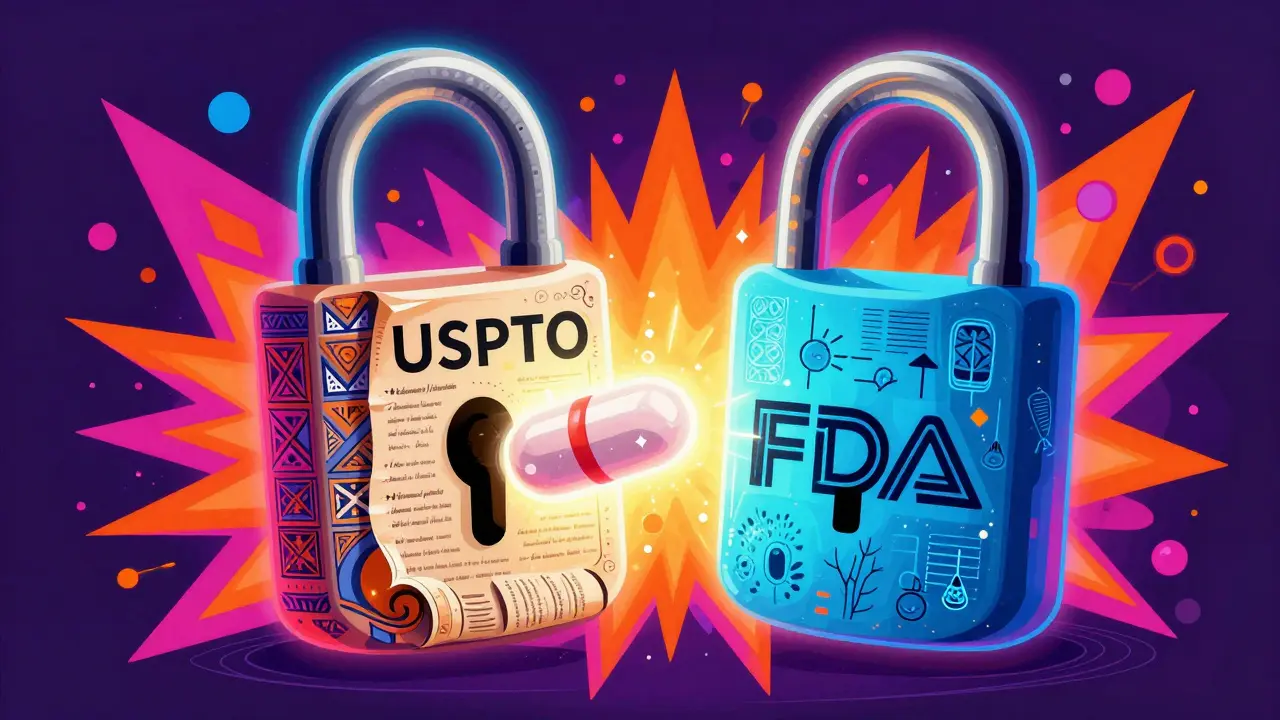
Imagine spending 10 years and $2.3 billion to develop a life-saving drug, only to have a competitor launch a cheaper version the day you hit the market. That is the nightmare pharmaceutical companies face. To prevent this, the US government uses two very different "locks" to keep competitors out: patent exclusivity is the first, and regulatory market exclusivity is the second. While they both aim to give a company a temporary monopoly, they are governed by different agencies and work in completely different ways.
If you're tracking a drug's lifecycle, you can't just look at the patent date and assume the market is open for generics. In many cases, a drug might be "off-patent" but still legally protected by the FDA. This "dual-key" system can be confusing, but understanding the difference is the only way to predict when a drug will actually become affordable for the public.
Who controls the keys?
The first big difference is who is in charge. Patents are handled by the United States Patent and Trademark Office (USPTO). A patent is essentially a contract: the government gives you a legal monopoly in exchange for you telling the world exactly how your invention works. However, patents aren't "self-enforcing." If a competitor ignores your patent, the USPTO won't do anything. You have to sue them in court to stop them from selling the product.
On the other hand, market exclusivity is granted by the Food and Drug Administration (FDA). This isn't about "inventions" but about the data used to prove a drug is safe. The FDA simply refuses to approve any competing generic applications (called ANDAs) until the exclusivity period ends. There is no lawsuit needed; the FDA just says "no" to the competitor.
The timing game: How long does protection last?
Patents generally last 20 years from the date you file the application. But here is the catch: you usually file the patent years before the drug is even approved. By the time a drug clears the 10-15 year development phase, you might only have 8 to 12 years of actual selling time left. To help with this, the law allows for Patent Term Extensions (PTE) to recover some of the time lost during FDA review, though this is capped at 5 years.
Market exclusivity starts only after the drug is approved. The length depends on the type of drug. For a New Chemical Entity (NCE), you typically get 5 years. If it's an Orphan Drug (for rare diseases), you get 7 years. Biologics, which are more complex than standard pills, get a massive 12-year window under the Biologics Price Competition and Innovation Act (BPCIA). You can even tack on an extra 6 months of "pediatric exclusivity" if you conduct studies on children.
| Feature | Patent Exclusivity | Market Exclusivity |
|---|---|---|
| Governing Body | USPTO | FDA |
| Basis for Grant | Novelty and Invention | Regulatory Approval/Data |
| Enforcement | Civil Lawsuits (Self-enforced) | FDA Approval Refusal |
| Typical Duration | 20 years from filing | 5 to 12 years post-approval |
Why do we need both?
You might wonder why one isn't enough. The reason is that some drugs are "new" to the market but not necessarily "new" inventions. For example, a company might take an old drug that's been used for centuries, find a new way to use it, and provide the clinical data to prove it works for a specific condition. They might not get a patent because the chemical itself isn't new, but the FDA will grant them market exclusivity because they did the hard work of proving the drug's safety and efficacy.
A wild example of this happened with the drug colchicine. It's been used since ancient times, so no one could get a strong patent on it. However, Mutual Pharmaceutical Company secured 10 years of regulatory exclusivity. Because the FDA wouldn't let anyone else in, the price of the drug jumped from 10 cents to nearly $5 per tablet. This shows that regulatory exclusivity can sometimes be even more powerful than a patent because it's an absolute block at the FDA level.
The "Evergreening" Strategy
Pharmaceutical companies often try to stretch these protections as long as possible, a tactic known as "evergreening." They do this by layering multiple patents-not just on the active molecule (composition of matter), but on the way the pill dissolves, the dosage, or the combination with another drug. These are called secondary patents.
While a primary patent might expire, a secondary patent can keep the competition out for another few years. Generic companies often try to break this cycle using a "Paragraph IV certification," where they challenge a patent in court, claiming it's invalid. If the generic company wins and is the first to successfully challenge the patent, they are rewarded with 180 days of their own market exclusivity. That six-month window can be worth hundreds of millions of dollars in revenue.
How it affects the real world
For a patient or a healthcare provider, this means the "patent cliff"-the date a drug loses patent protection-isn't always the day prices drop. If the FDA has granted a 5-year NCE exclusivity and the patent expires in year 3, the generic versions still can't enter for another 2 years.
This complexity is why biotech companies spend millions on legal teams. Many small firms actually rely more on regulatory exclusivity than patents, especially for biologics. Since biologics are so hard to copy, the 12-year FDA block is often a more reliable shield than a patent that could be overturned in a courtroom.
Can a drug have both patent and market exclusivity?
Yes, and it happens frequently. In fact, nearly 28% of branded drugs have both. They run concurrently, meaning the drug is protected by both the USPTO and the FDA. In this case, the protection lasts until the last of the two expires.
What happens if a patent is overturned but the FDA exclusivity is still active?
The competitor can no longer be sued for patent infringement, but the FDA still won't approve their generic application. The market exclusivity acts as a second wall that prevents the product from officially entering the US market via the FDA approval process.
Why are biologics exclusivity periods longer?
Biologics are much more complex to manufacture than small-molecule drugs. Because the cost and risk of developing "biosimilars" (the biologic version of generics) are so high, the government provides a longer 12-year period to ensure innovators can recoup their investment.
What is an Orphan Drug and how does it affect exclusivity?
An Orphan Drug is one intended to treat a rare disease (affecting a small number of people). Because there's less profit incentive to develop these, the FDA grants a special 7-year market exclusivity period to encourage companies to take the risk.
Where can I check the exclusivity status of a drug?
The best resource is the FDA's Orange Book (Approved Drug Products with Therapeutic Equivalence Evaluations) or the newer FDA Exclusivity Dashboard, which provides real-time tracking of these periods.
What to do next
If you are a developer or an investor, don't rely on a single date. You need to map out the entire timeline: when the patent was filed, when the drug was approved, and which specific FDA exclusivity categories apply.
For those looking for cheaper alternatives, keep an eye on the "Paragraph IV" challenges. When you see a generic company suing a brand-name company, it's often a sign that a battle for that 180-day exclusivity window is happening, and a price drop may be on the horizon. If you're unsure about a specific drug, the FDA's Drugs@FDA database is the most reliable way to see exactly what protections are currently in place.
everyone knows evergreening is just a fancy word for corporate greed 🙄
it is truly a fascinatng paradox how the human drive for innovation is inextricably tied to the artificial restriction of access and one must wonder if the very essence of medicine is being subsumed by the cold machinery of capital where a life saving molecule is treated as a piece of real estate to be fenced off by legal trickery for as long as the ink stays wet on the paperwork which just proves that our legal structures are merely echoes of primitive tribal territoriality scaled up to a corporate level
Imagine thinking a 20-year patent is "too short" for these guys. Most of these companies just tweak the coating of a pill and call it a new invention. It's a joke. If you're investing in this, you're basically just gambling on which lawyer is the most aggressive.
Oh, wonderful! So we just let companies hold people hostage for 12 years because a biologic is "complex"? 🙄 Absolute madness! Who decided this was moral? I bet the people who wrote these laws have never paid for a single prescription in their lives! 😱
The sheer arrogance of the US system is astounding. They create these convoluted "locks" to ensure their own corporations maintain a global hegemony over healthcare. India provides the world with affordable generics because we actually value human life over the bloated profit margins of Wall Street. It is a systemic failure of the American dream to prioritize a patent filing date over a patient's survival. The FDA is nothing more than a concierge service for Big Pharma, ensuring that no one can enter the market until the shareholders have squeezed every last cent from the suffering masses. Truly pathetic.
actually... the nuance here is totally missed... the USPTO's role is far more rudimentary than presented... its barely even a hurdle for any real pharma giant,,, and only a novice would rely on patents alone....
It's interesting how we equate the value of a discovery with the length of its exclusivity. We've turned the act of healing into a timed game of musical chairs.
Exactly! We need to push for a global standard that actually prioritizes the patient. The Paragraph IV process is a start, but it's way too slow. Let's get these generics on the market faster!
I'm sure the "Orange Book" is just a list of which companies are paying off the FDA to keep the prices high. It's all a coordinated effort to keep us dependent on expensive meds while they hide the real cures.
Let's focus on the positive! At least we have these pathways to eventually get cheaper meds. Keep fighting for access! 💪✨
Keep pushing forward! The generic companies are the real rockstars here fighting the big bosses to bring prices down for everyone! Lets gooo!
It is heartening to see such a passionate discussion regarding the accessibility of medication... perhaps we can find a middle ground where innovation is rewarded, but humanity is not forgotten...!!!