
When you have diabetes, managing your blood sugar isn’t just about taking medication. It’s about understanding what your numbers really mean-and how to use them every day to stay healthy. Two tools stand at the center of this: your A1C and your daily glucose readings. But they don’t tell the same story. One shows the big picture. The other shows the minute-by-minute reality. Getting both right can mean the difference between feeling fine and ending up in the hospital.
What A1C Really Measures (And What It Doesn’t)
Your A1C test gives you a three-month average of your blood sugar. It works by measuring how much glucose has stuck to your red blood cells. Since those cells live about 120 days, the test reflects your overall control over that time. A result of 7% means your average blood sugar has been around 154 mg/dL. That’s the number most doctors aim for.
But here’s the catch: A1C hides the spikes and drops. Two people can have the same A1C of 7%, but one spends most of the day between 80 and 140 mg/dL. The other swings from 50 mg/dL at 3 a.m. to 250 mg/dL after dinner. Their A1C looks identical. But their risks? Totally different.
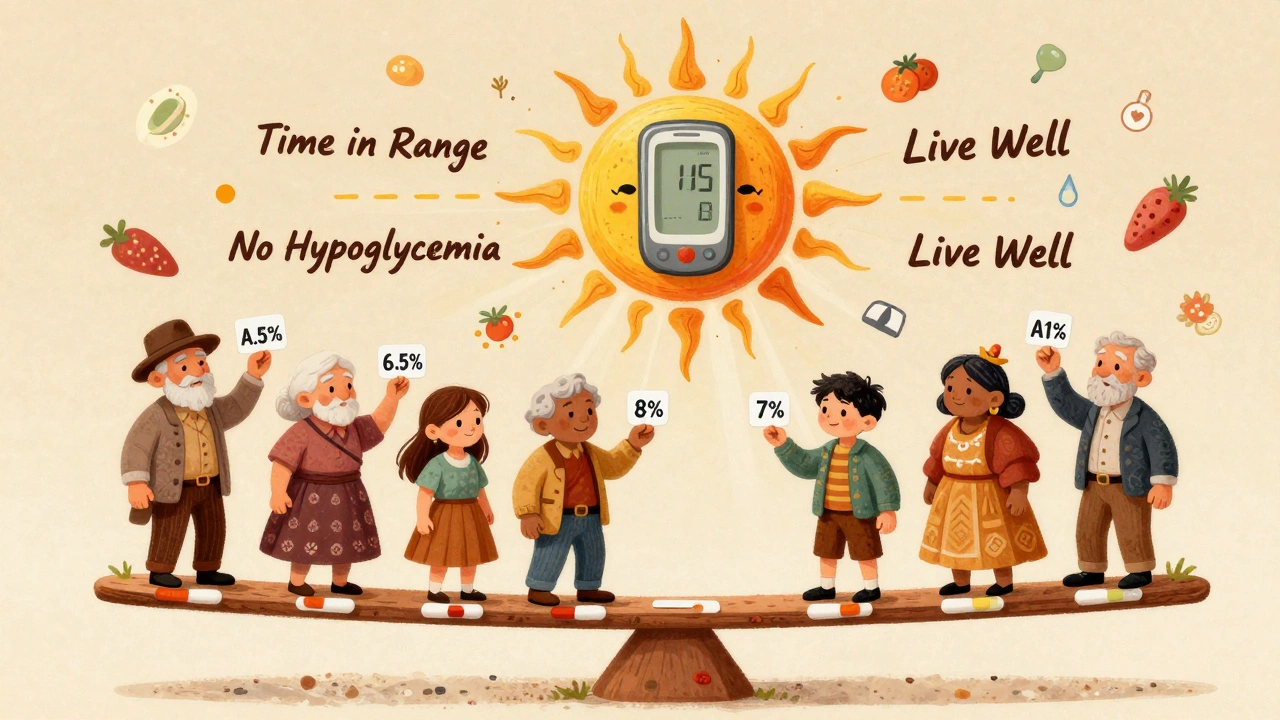
The American Diabetes Association (ADA) recommends an A1C below 7% for most adults with diabetes. But that’s not a one-size-fits-all rule. For someone young and healthy with type 1 diabetes, aiming for 6.5% might be safe and helpful. For an older adult with heart disease or who gets low blood sugar easily, 8% might be the better goal. The American College of Physicians (ACP) says 7-8% is enough for many people with type 2 diabetes because going lower doesn’t stop heart attacks or extend life-but it does raise the risk of dangerous lows.
And A1C isn’t perfect. If you have anemia, kidney disease, or certain genetic traits (common in people of African, Mediterranean, or Southeast Asian descent), your A1C can be misleading. A lab result might look normal when your blood sugar is actually running high. That’s why daily monitoring isn’t optional-it’s essential.
Daily Glucose Monitoring: Fingersticks vs. Continuous Sensors
Daily glucose monitoring comes in two main forms: fingerstick meters and continuous glucose monitors (CGMs). Fingerstick meters have been around for decades. You prick your finger, put a drop of blood on a strip, and wait a few seconds for the number. They’re cheap, reliable, and covered by most insurance. Medicare pays for 100 test strips a month if you use insulin, and 100 every three months if you don’t.
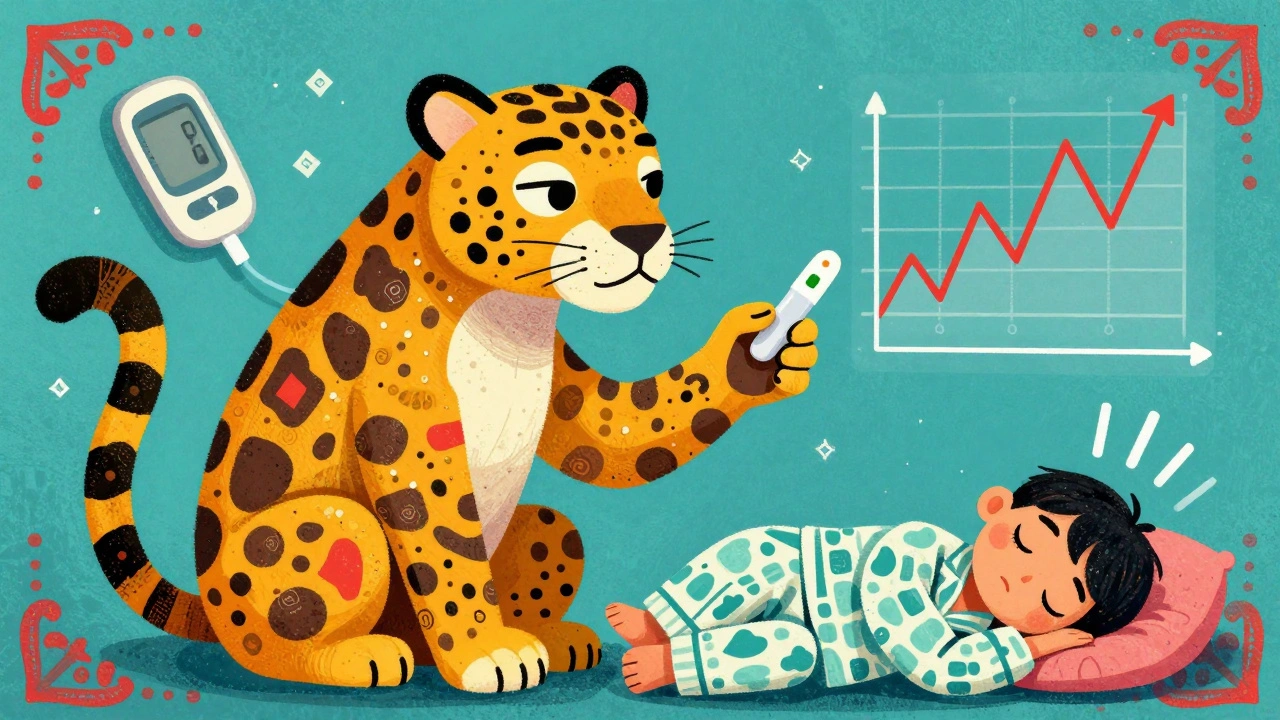
But they only give you a snapshot. One reading at 7 a.m. doesn’t tell you what happened at 2 a.m. or after lunch. That’s where CGMs come in. Devices like the Dexcom G7 and Abbott FreeStyle Libre 3 measure glucose in your interstitial fluid through a tiny sensor worn on your arm or belly. They update every minute, 24/7. You can see trends-whether your sugar is rising, falling, or holding steady.
CGMs also warn you when your glucose is dropping too fast. That’s huge for people who don’t feel low blood sugar coming. In a 2022 survey, 83% of CGM users said seeing real-time trends helped them make better food and activity choices. One user in Flagstaff told me she stopped having nighttime lows after her CGM alerted her to a slow drop at 1 a.m.-something her fingerstick never caught.
But CGMs aren’t perfect. They cost $100-$150 a month out of pocket if you’re not covered by insurance. Medicare now covers them for anyone on insulin, and starting in 2024, they’re expanding coverage to non-insulin users who have frequent lows. Still, many people ration strips or skip sensor changes because of cost. And sensors can be off by up to 10-15% if not calibrated properly. That’s why it’s still smart to check with a fingerstick if your CGM says you’re crashing and you feel fine.
What Your Numbers Should Be (Beyond A1C)
Most people focus on A1C alone. But experts now say you need more than one number to really understand your control. The ADA’s 2023 guidelines recommend three key goals for daily monitoring:
- Time in Range (TIR): Spend at least 70% of your day between 70 and 180 mg/dL. That’s the sweet spot.
- Time below 70 mg/dL: Less than 4% of your day. That’s about 57 minutes. More than that means you’re at risk for dangerous lows.
- Time below 54 mg/dL: Less than 1% of your day. That’s 14 minutes or less. This is the zone where confusion, seizures, or unconsciousness can happen.
These numbers come from real-world data collected from millions of CGM readings. If you hit 70% TIR, your A1C will likely be around 7%. But if you’re only at 50% TIR, you’re probably spending too much time above 180 or below 70-and your A1C might be hiding that.
For meals, the ADA suggests keeping your blood sugar under 180 mg/dL two hours after eating. Before meals, aim for 80-130 mg/dL. But again, this depends on you. If you’re active, you might need to eat more to avoid lows. If you’re sedentary, even a small carb-heavy snack can send you over 200. Your numbers aren’t set in stone-they’re a starting point.
Why One Size Doesn’t Fit All
Not everyone should aim for the same A1C. Think about your life. Are you 25 and training for a marathon? You can probably handle tighter control. Are you 75, living alone, and taking five different medications? Pushing for 6.5% might put you at risk for falls, confusion, or ER visits.
A 2022 study in Diabetes Care found that 34% of low-income patients couldn’t afford enough test strips or CGM sensors to meet standard targets. For them, a higher A1C goal isn’t giving up-it’s survival. Your doctor should ask: What’s your daily life like? Do you have help? Can you afford your supplies? Are you scared of lows?
One woman I spoke with, a grandmother in her 70s, had been told to get her A1C under 7%. She had three hypoglycemic episodes in six months. Her doctor finally changed her goal to 8%. She stopped panicking before meals. She started eating snacks when she felt off. Her quality of life improved instantly. Her A1C didn’t drop-but she wasn’t in the hospital anymore.
That’s the truth: the goal isn’t to hit a number. It’s to live well.
How Often Should You Test?
If you’re on insulin, test at least four times a day: before meals and at bedtime. If you’re using a CGM, you might test less often-but still check with a fingerstick if your sensor disagrees with how you feel.
If you’re on pills or diet alone, you might only need to test once or twice a week. But don’t skip it. A 2021 study showed people who tested regularly were 78% more likely to recognize patterns-like how pasta spikes their sugar or how walking after dinner brings it down.
And don’t forget A1C checks. Get tested every three months if your treatment has changed or your numbers are off target. If you’re stable, twice a year is fine. Some clinics offer point-of-care A1C tests that give results in five minutes. That’s great for quick feedback.
What’s New and What’s Coming
Technology is moving fast. Hybrid closed-loop systems-like Tandem’s Control-IQ-automatically adjust insulin based on CGM data. Real-world data shows they boost time-in-range by over 12% and lower A1C by half a point. They’re not perfect, but they’re a big step toward hands-off control.
Next up? Non-invasive monitoring. Companies like Dexcom and Google are working on contact lenses and wristbands that measure glucose without a sensor. Don’t expect them to be widely available before 2026, but they’re coming.
And the guidelines are changing. The ADA now includes social factors in target setting. If you’re food insecure, homeless, or lack transportation to appointments, your target should reflect that. No one should be shamed for not hitting a number they can’t afford to reach.
What to Do Next
If you’re managing diabetes, here’s what to ask your doctor:
- What’s my current A1C, and what should it be based on my age, health, and lifestyle?
- Am I a good candidate for a CGM? Can we check if my insurance covers it?
- Can we look at my glucose trends together? I want to see when I’m going high or low.
- What’s my time-in-range? Is it above 70%?
- Are my supplies covered? If not, what’s the cheapest way to get them?
And if you’re feeling overwhelmed? Start small. Pick one thing: maybe test before breakfast for a week. Or wear a CGM for 14 days just to see how your body reacts to food. You don’t need to fix everything at once.
Diabetes management isn’t about perfection. It’s about awareness. It’s about knowing your numbers, understanding what they mean, and using them to make choices that let you live your life-not just survive it.
What’s a normal A1C level for someone without diabetes?
For someone without diabetes, a normal A1C level is below 5.7%. Between 5.7% and 6.4% is considered prediabetes, and 6.5% or higher on two separate tests means diabetes. These ranges are set by the CDC and ADA and apply to most people regardless of age or race.
Can I trust my CGM without checking with a fingerstick?
CGMs are accurate, but they’re not perfect. Always check with a fingerstick if your CGM shows a very low or very high number and you feel symptoms-like shakiness, confusion, or dizziness. Sensors measure glucose in fluid between cells, not directly in your blood, so there can be a 5-15 minute delay. Fingersticks give you the real-time number when it matters most.
Why does my A1C seem high even though my daily readings are good?
That’s called "A1C denial." It happens when you have good average readings but spend a lot of time above 200 mg/dL after meals or at night. Your CGM might show you’re in range most of the day, but if you spike high for a few hours daily, that raises your A1C. Look at your glucose trends-especially post-meal spikes-and talk to your doctor about adjusting your meals or meds.
Is a higher A1C target safer for older adults?
Yes. For older adults, especially those with other health problems, a target of 7.5-8% is often safer than aiming for 6.5-7%. Tight control increases the risk of dangerous low blood sugar episodes, which can lead to falls, confusion, or heart problems. The benefits of lower A1C take years to show up, but the risks of lows happen immediately. Quality of life matters more than a number.
How can I afford glucose monitoring supplies if I’m on a tight budget?
Medicare and many private insurers cover test strips and CGMs if you use insulin. If you’re uninsured or underinsured, ask your doctor for samples, check with patient assistance programs from manufacturers like Abbott and Dexcom, or visit a community health center. Some pharmacies sell generic strips for under $10 for 50. Never ration supplies to the point you’re not testing-your health is worth more than the cost.

12 Comments
Write a comment