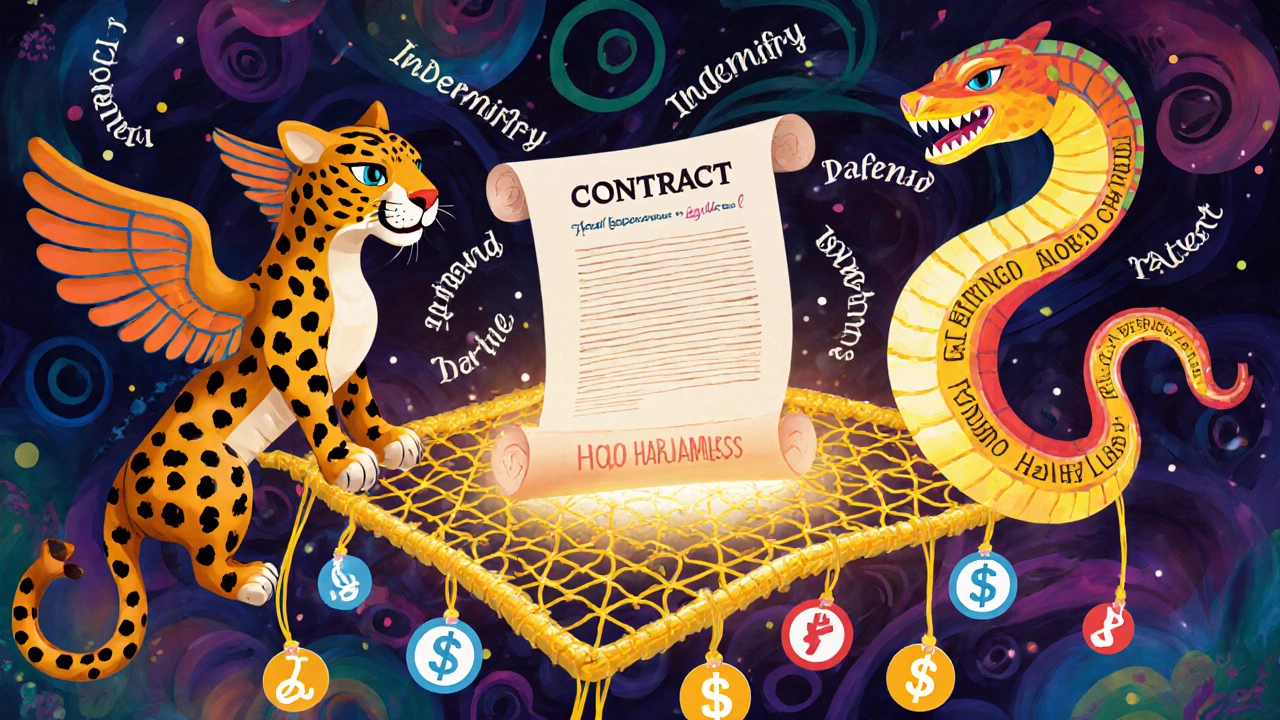
When two parties sign a contract-whether it’s a software license, a service agreement, or a small business purchase-they’re not just exchanging goods or services. They’re also swapping risk. And that’s where indemnification comes in. It’s not legalese for the sake of it. It’s the safety net that tells you, if something goes wrong, this person pays for it.
What Indemnification Actually Means
Indemnification is a promise in a contract. One party (the indemnifier) agrees to cover the costs if the other party (the indemnitee) gets sued, fined, or loses money because of something tied to the deal. It’s not about blame-it’s about who foots the bill. For example, if you buy a piece of software and it turns out to violate someone else’s patent, the vendor might have to pay your legal fees and any settlement. That’s indemnification in action.
The legal definition is simple: to indemnify means to compensate someone for losses they’ve suffered. That includes court costs, attorney fees, settlements, and even fines. It’s not just about money-it’s about control. The party being indemnified doesn’t have to carry the burden alone.
How It Works in Real Transactions
Imagine you’re a small business buying a customer database from another company. The seller says the data is legally obtained. But months later, you get a lawsuit because the data was stolen. Without indemnification, you’re stuck paying for lawyers and damages. With it, the seller has to step in and fix it.
This isn’t rare. It’s in nearly every commercial deal. From buying a company to hiring a contractor, indemnification clauses are standard. They exist because no one wants to be blindsided by hidden risks. The buyer wants protection. The seller wants to limit exposure. That’s the tension.
The Seven Parts of a Strong Indemnity Clause
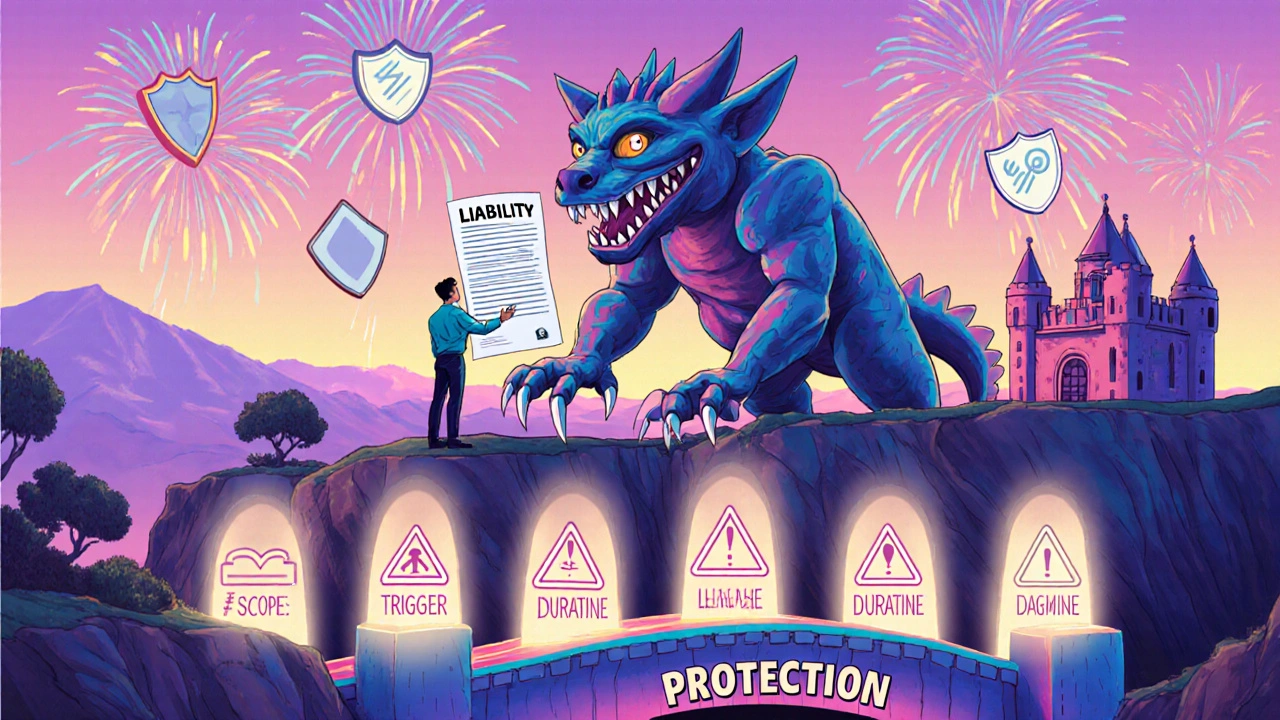
A weak indemnity clause is worse than none at all. It creates confusion. A good one has seven clear parts:
- Scope of Indemnification - What exactly is covered? Legal fees? Third-party claims? Tax penalties? Vague language like "all losses" invites fights. Specificity wins.
- Triggering Events - What starts the obligation? Breach of contract? Negligence? Violating a law? Each event must be clearly defined. A data breach caused by poor security? That’s a trigger. A customer complaint about slow service? Probably not.
- Duration - How long does the protection last? Some clauses expire when the contract ends. Others last years-especially for things like tax liabilities or intellectual property claims.
- Limitations and Exclusions - No one pays for everything. Most agreements exclude indirect damages (like lost profits) or punitive fines. These limits are critical for sellers to avoid being on the hook for unlimited losses.
- Claim Procedures - You can’t just send a bill. Most contracts require written notice within 30 or 60 days. Missing the deadline? You might lose your right to claim.
- Insurance Requirements - Does the indemnifying party have to carry insurance? If so, what kind? $1 million in general liability? Errors and omissions? This ensures they can actually pay if they have to.
- Governing Law and Jurisdiction - If there’s a dispute, where does it get settled? In California? New York? Which state’s laws apply? This avoids costly forum shopping.
Unilateral vs. Mutual Indemnification
Not all indemnity clauses are created equal. There are two main types:
- Unilateral - Only one side promises to pay. This is common in vendor-customer deals. The software company indemnifies the buyer for IP infringement. The buyer doesn’t owe anything back. It’s a power imbalance. The buyer has leverage; the vendor has to accept it to get the deal.
- Mutual - Both sides protect each other. This happens more in joint ventures, construction contracts, or partnerships where both parties face similar risks. If a worker gets hurt on site, both parties cover each other’s liability.
Unilateral is the norm. Mutual is the exception. If you’re the seller, expect to be the one paying. If you’re the buyer, push for broad protection.
What’s the Difference Between Indemnify, Defend, and Hold Harmless?
People mix these up. They’re not the same.
- Indemnify = Pay for losses after they happen.
- Defend = Pay for lawyers and court costs to fight the claim.
- Hold Harmless = Promise not to sue the other party, even if they caused the problem.
Some contracts say "indemnify, defend, and hold harmless." That’s redundant in many states. But it doesn’t hurt. Courts usually treat it as one broad obligation. Still, knowing the difference helps you negotiate. If you’re the seller, you might push to remove "defend"-because controlling your own defense is expensive and risky.
Fundamental vs. Non-Fundamental Representations
In business sales, indemnification often ties to what the seller promises about the company. These promises are called "representations and warranties."
- Fundamental reps - Core truths: "We own the business," "We have the legal right to sell it," "There are no hidden taxes or lawsuits." These usually survive for years-even up to the statute of limitations on fraud.
- Non-fundamental reps - Operational stuff: "Our employees are properly classified," "Our software licenses are current." These often expire after 12 to 24 months.
This matters because if a fundamental rep turns out false, the buyer can come back years later and demand payment. A non-fundamental one? The clock runs out faster.
Why Sellers Hate Indemnification Clauses
Sellers don’t want to be the bank. They know that indemnification can turn a small mistake into a huge liability. A single misstatement about a contract or a tax filing could cost them hundreds of thousands.
That’s why sellers fight hard for:
- Lower caps - "We won’t pay more than 10% of the sale price."
- Deductibles - "You only get paid if losses exceed $50,000."
- Short survival periods - "No claims after 18 months."
- Exclusions for consequential damages - "No lost profits. No reputational harm."
Buyers push back. They want full coverage. The negotiation is brutal. But it’s normal. In fact, indemnification clauses are among the most heavily negotiated parts of any deal.

Real-World Example: Software Licensing
Let’s say a startup sells a cloud-based HR tool to a Fortune 500 company. The contract says the startup will indemnify the buyer if the software infringes on someone’s patent.
Two years later, a patent troll sues the big company. The lawsuit costs $800,000 in legal fees. The company files an indemnification claim.
The startup has to pay the fees. But here’s the catch: the contract says the buyer must notify them within 10 days of being sued. The buyer waited 45 days. Now the startup says, "Too late. No coverage."
That’s why procedures matter. Even the best clause fails if you don’t follow the steps.
What Happens If There’s No Indemnification Clause?
Then you’re relying on the law. And the law is slow, unpredictable, and expensive.
Without a contract, you might still have a claim under negligence or breach of warranty-but proving it takes years. You’ll need evidence, witnesses, expert testimony. Meanwhile, your business is bleeding money.
Indemnification is insurance you design yourself. It’s faster, clearer, and more reliable than going to court.
Final Tips for Negotiating Indemnification
- Don’t use boilerplate. Tailor it to your deal.
- Define every term. "Losses" isn’t enough. List them.
- Set clear deadlines for notice. 30 days is standard.
- Require proof of insurance if the indemnifying party is small.
- For sellers: cap liability, add deductibles, limit survival periods.
- For buyers: push for broad scope, no caps on defense costs, and long survival for key reps.
Indemnification isn’t about distrust. It’s about planning for what could go wrong. The best deals aren’t the ones with no risk. They’re the ones where everyone knows who pays when it happens.
Is indemnification the same as insurance?
No. Insurance is a policy you buy from a company that pays out if a covered event happens. Indemnification is a promise between two parties in a contract. One agrees to pay the other directly. Insurance can back up indemnification, but it’s not required. Many small businesses rely on indemnification alone because they can’t afford insurance.
Can I waive indemnification entirely?
Technically yes, but it’s rare and risky. Most buyers won’t sign without it, especially in deals involving software, real estate, or services. Sellers sometimes refuse to indemnify-but then they lose the deal. The only time it’s common is in very small, low-risk transactions between trusted parties. Even then, it’s not wise.
What if the indemnifying party goes bankrupt?
Then you’re out of luck. That’s why insurance requirements matter. If the contract says the indemnifying party must carry $2 million in coverage, you have a better chance of getting paid-even if they go under. Always check their financial health before signing.
Do indemnification clauses work in all states?
Most do, but some states limit them. For example, California and New York restrict indemnification for negligence if it’s the indemnitee’s own fault. Some states won’t enforce "hold harmless" clauses in construction contracts unless they’re very clear. Always have a lawyer review the governing law section.
Can I negotiate indemnification after the contract is signed?
Not easily. Once signed, the contract is binding. Any changes require a written amendment signed by both parties. That’s why it’s critical to get it right before you sign. Don’t assume you can fix it later.
Indemnification my ass
Most of these clauses are just corporate bullying disguised as protection
Small biz gets screwed every time and nobody talks about it
You think you're getting safety but you're just signing away your future
And don't even get me started on that 'defend' part
They'll drag you through court for years and still blame you for the mess
This whole system is rigged
The structural asymmetry inherent in unilateral indemnification frameworks reflects a classic principal-agent problem wherein risk allocation is disproportionately externalized to the party with lesser bargaining power
Furthermore, the operationalization of claim procedures often introduces procedural barriers that function as de facto estoppel mechanisms
One must also consider the moral hazard implications of indemnity clauses that disincentivize due diligence on the part of the indemnitee
These are not merely contractual terms-they are institutionalized power dynamics
This is actually one of the clearest explanations I've seen on indemnification
Especially the breakdown of the seven parts-I’ll be saving this for my team
As someone who works with international vendors, the governing law section is something we always overlook until it's too late
Also, the insurance requirement point? Critical. I once saw a startup promise $2M in coverage but had zero policies
Don't sign until you verify
Thanks for writing this
Indemnification...? What a pathetic, cowardly, bureaucratic crutch for people who can't handle risk...
Real men don't sign indemnity clauses-they sign contracts with their blood, their honor, their word...
And if someone sues you? You face it. You don't hide behind legalese like a corporate lawyer's puppet...
This whole system is a symptom of America's decline-no one wants responsibility anymore, they just want a paper shield...
And don't even get me started on 'mutual' indemnity... that's just two cowards pointing at each other and saying 'you first'...
Real business was built on trust... not clauses...
...and now we're all just lawyers with spreadsheets...
What a sad, sad world we live in...
Okay but imagine if you’re the vendor and you’re a tiny startup and someone sues you for $5M because your software ‘allegedly’ infringed a patent that was filed 3 years after you launched...
And you’ve got a $100K cap...
And the buyer waited 45 days to notify you...
And now you’re being sued by your own client AND the patent troll...
And your insurance company says ‘sorry, breach of notice’...
And you have to sell your house...
And your kid’s college fund is gone...
And you’re sitting in a parking lot crying because you thought this was a ‘simple software license’...
And now you’re wondering if you should’ve just stayed a barista...
That’s not risk management.
That’s a nightmare dressed in a PDF.
And they call this ‘standard practice’...
...I’m not even mad.
I’m just... done.
Thanks for the detailed breakdown. Very helpful.
Just wanted to add that in the EU, indemnification clauses are often interpreted more narrowly than in the US, especially under GDPR-related liabilities.
Also, in Germany, 'hold harmless' clauses are frequently voided if they attempt to waive liability for gross negligence.
Always check local law-even if the contract says 'California law applies', local regulators may still step in.
Good stuff overall 👍
YES. The notice period thing is everything.
I had a client miss the 30-day window and then act shocked when they got denied.
Like... you read the contract right? Right??
Just... read it.
It's not that hard.
This is gold. I teach contract law to junior lawyers and I’m stealing this for my slides.
Especially the fundamental vs. non-fundamental reps breakdown-that’s the one thing students always mix up.
Also, the insurance point? So many people forget that indemnity is only as good as the party behind it.
If your indemnifier is a shell company with $2 in the bank and no policy? You’re not protected.
Always ask: ‘Can they actually pay?’
Not ‘Do they promise to?’
That’s the difference between legal theory and real-world survival.
Thank you for writing this.