Imagine walking into a pharmacy and being told that the medication you’ve taken for years is simply not available. It’s not a rare, experimental treatment-it’s a generic version of a common antibiotic or heart medicine. This scenario has become all too familiar for millions of Americans. While generic drugs make up 90% of prescriptions filled in the United States, they are frequently at the center of chronic shortages. The reason isn’t a lack of demand; it’s a complex web of manufacturing constraints, economic pressures, and global supply chain vulnerabilities.
The modern generic industry was born from the Hatch-Waxman Act of 1984, which created a pathway for companies to produce cheaper versions of brand-name drugs once patents expired. Today, however, this system is under severe strain. In October 2023, the U.S. Food and Drug Administration (FDA) reported 278 active drug shortages, with 67% involving generic medications. To understand why this happens, we need to look beyond simple production errors and examine the structural flaws in how these life-saving medicines are made and sold.
The Global Supply Chain Bottleneck
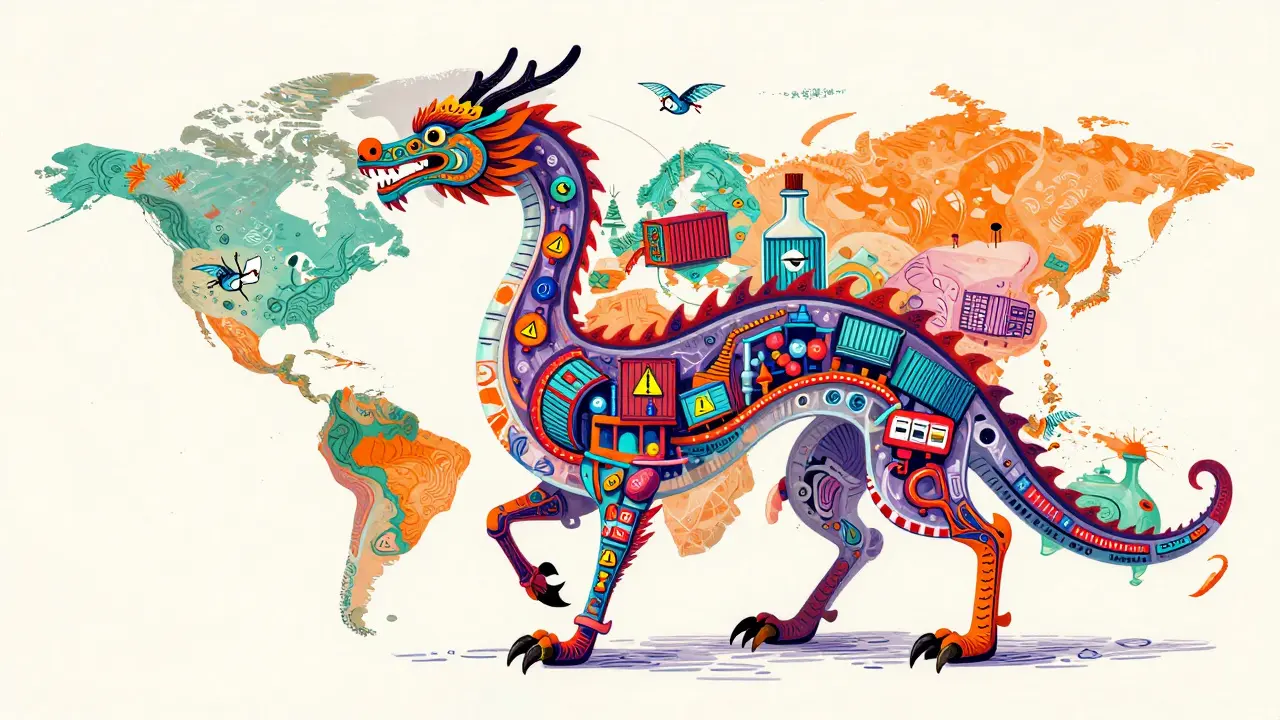
One of the biggest issues facing generic manufacturers is where the raw materials come from. The active pharmaceutical ingredient (API)-the actual chemical compound that treats your condition-is rarely made in the same country as the final pill. As of 2023, 72% of API manufacturing facilities approved for U.S. drugs are located outside the United States. For some critical categories, the dependency is even starker: 97% of antibiotics and 92% of antivirals have no domestic API source.
This globalization creates a fragile supply chain. A single disruption in one part of the world can ripple through the entire system. During the early stages of the pandemic, when 44 pharmaceutical facilities in China became inoperable and India halted exports of 26 essential medicines, the U.S. faced immediate shortages of basics like acetaminophen. The problem is compounded by the fact that APIs are often produced in one country, combined with inactive ingredients in another, coated in a third, and packaged elsewhere. Each handoff adds risk and complexity.
Consider the case of Intas Pharmaceuticals, an Indian manufacturer whose quality issues led to the removal of cisplatin, a critical cancer drug, from the U.S. market in 2022. Such incidents highlight the challenges of maintaining consistent quality control across borders where regulatory oversight may differ significantly.
Economic Pressures and the Race to the Bottom
If supply chains were the only issue, we might see occasional shortages. But the real driver of chronic scarcity is economic instability. Generic manufacturers operate on razor-thin margins, often between 15% and 20%, compared to the 70-80% gross margins enjoyed by branded pharmaceutical companies. Some products dip below 5% during intense price competition.
This pressure comes from the procurement system. Group purchasing organizations (GPOs) and pharmacy benefit managers (PBMs) negotiate contracts based on tiny price differences-sometimes less than one-tenth of a cent per tablet. This creates a "race to the bottom" where manufacturers are forced to cut costs to stay competitive. When Akorn Pharmaceuticals filed for bankruptcy in February 2023, the immediate recall of their products caused instant shortages because there were few alternative suppliers willing or able to step in quickly.
Anthony Sardella of Washington University’s Olin School of Business describes this as "price erosion." Manufacturers cannot justify investing in modern equipment or expanding capacity when their revenue is constantly squeezed. The result is reduced production capacity and compromised quality, leading directly to drug shortages.
Regulatory Hurdles and Compliance Costs
Manufacturing generics in the United States is expensive and time-consuming. Establishing a new FDA-compliant facility costs approximately $250-$500 million and takes 3-5 years. In contrast, setting up similar operations in India or China can cost just $50-$100 million. This disparity incentivizes offshoring, further weakening domestic production capabilities.
The regulatory burden is significant. Manufacturers must maintain documentation for 5-7 years and undergo unannounced inspections. Non-compliance penalties average $2.3 million per violation. Responding to FDA Form 483 observations-which list inspection deficiencies-requires 12-18 months of corrective action costing around $1.7 million per facility. These costs add up, making it difficult for smaller manufacturers to survive.
Furthermore, the learning curve for new entrants is steep. Companies typically lose money for 3-5 years before achieving profitability due to high development costs and regulatory submission fees averaging $2.6 million per Abbreviated New Drug Application (ANDA). This financial barrier limits competition and reduces resilience in the market.
Quality vs. Price: A Dangerous Trade-off
The focus on low prices often comes at the expense of quality. Dr. Ameet Sarpatwari of Harvard Medical School notes that the generic market is "totally focused on price and not on product quality or supply chain quality." This mindset leads to predictable outcomes: major recalls and shortages are not random accidents but inevitable results of a system that rewards the lowest bidder without adequately valuing reliability.
A 2023 study cited by MedShadow.org found that generic drugs manufactured in India were associated with 54% more serious adverse events compared to identical drugs made in the U.S. While correlation doesn’t prove causation, it raises concerns about consistency. Patients report having to switch brands frequently, leading to confusion and potential health risks. One Medicare beneficiary documented a jump from $10 to $450 monthly for a heart medication during a shortage, highlighting the personal impact of these systemic failures.
Real-World Impact on Healthcare Providers
The consequences of these constraints are felt most acutely by healthcare providers and patients. On Reddit’s r/pharmacy community, hospital pharmacists documented switching to alternative antibiotics for 17 different infections over six months due to shortages. Nurse practitioners reported managing levothyroxine shortages by carefully monitoring patients switched to alternative brands.
Consumer complaints on the FDA’s drug shortage portal increased by 327% between 2019 and 2022. Critical medications like epinephrine, cancer treatments, and essential generics are frequently affected. This instability forces doctors to spend extra time finding alternatives, delaying care and increasing stress for both providers and patients.
| Factor | Branded Drugs | Generic Drugs |
|---|---|---|
| Gross Margins | 70-80% | 15-20% (sometimes <5%) |
| Market Share | ~10% of prescriptions | ~90% of prescriptions |
| Spending Contribution | ~80% of total drug spending | ~20% of total drug spending |
| Supply Chain Resilience | High (single manufacturer) | Low (multiple fragmented suppliers) |
| Shortage Frequency | Rare | Chronic |
Future Outlook and Potential Solutions
The crisis shows no signs of abating without structural changes. Industry analysts project that the number of generic drug manufacturers serving the U.S. market will decline from 127 in 2022 to 89 by 2027. However, there are glimmers of hope. The FDA’s Emerging Technology Program has approved 12 continuous manufacturing facilities since 2019, offering better process control and real-time quality monitoring. Although these represent less than 3% of total capacity, they point toward a more resilient future.
Bipartisan legislation introduced in 2023 aims to provide tax incentives for domestic API manufacturing and establish strategic stockpiles of critical medicines. Additionally, hospitals are increasingly bypassing GPOs to enter direct contracts with manufacturers, a strategy adopted by 68% of health systems in 2023 compared to 32% in 2020. These shifts could help stabilize the market if supported by broader policy reforms.
Experts like Dr. Aaron Kesselheim suggest that strategic consolidation and targeted government intervention could stabilize the market by 2028. Without such measures, however, experts predict at least 15 major drug shortages annually through 2030. The path forward requires balancing affordability with reliability, ensuring that patients have access to safe, effective medications without compromising the integrity of the supply chain.
Why are generic drugs so cheap if they face shortages?
Generic drugs are cheap because manufacturers compete fiercely on price, often driving margins below 5%. This intense competition discourages investment in robust supply chains and quality controls, leading to fragility and frequent shortages.
What is the role of the Hatch-Waxman Act in current shortages?
The Hatch-Waxman Act established the legal framework for generic drug approval via the ANDA pathway. While it increased access to affordable meds, the resulting market structure prioritized low prices over supply chain resilience, contributing to today's shortages.
How does outsourcing API production affect drug availability?
Outsourcing API production to countries like India and China creates dependency on foreign infrastructure. Disruptions in these regions, whether due to natural disasters, political issues, or quality failures, can quickly lead to U.S. shortages.
Are generic drugs less effective than brand-name drugs?
Generics are required to be bioequivalent to brand-name drugs. However, inconsistent manufacturing practices and quality control issues in some overseas facilities can lead to variations in performance and higher rates of adverse events.
What can patients do during a generic drug shortage?
Patients should consult their healthcare provider for alternative therapies or brands. They can also check the FDA’s drug shortage website for updates and consider joining patient advocacy groups to stay informed about emerging solutions.
Will domestic manufacturing solve the shortage problem?
Increasing domestic API production could enhance supply chain resilience. However, it requires significant capital investment and regulatory support to overcome the cost disadvantages currently favoring offshore manufacturing.
How do GPOs contribute to drug shortages?
Group Purchasing Organizations negotiate contracts based on minimal price differences, forcing manufacturers to cut corners. This "race to the bottom" undermines profitability and discourages investments in reliable production methods.
What is continuous manufacturing?
Continuous manufacturing is an advanced technology that allows for real-time quality monitoring and superior process control compared to traditional batch methods. It improves efficiency and reliability but requires high upfront capital investment.