Medication Adherence Calculator
How Well Are You Taking Your Medication?
Calculate your adherence rate and see how digital pill technology could help improve it based on clinical data from the article.
Every year, half of the people taking medication for chronic conditions skip doses or stop altogether. It’s not laziness. It’s forgetfulness, fear of side effects, cost, or simply not feeling sick enough to bother. But what if your pill could tell you-and your doctor-when you actually took it? That’s not science fiction. Digital pill sensors are already here, quietly tracking whether you swallowed your medicine and, increasingly, what your body is doing after you do.
How Digital Pills Actually Work
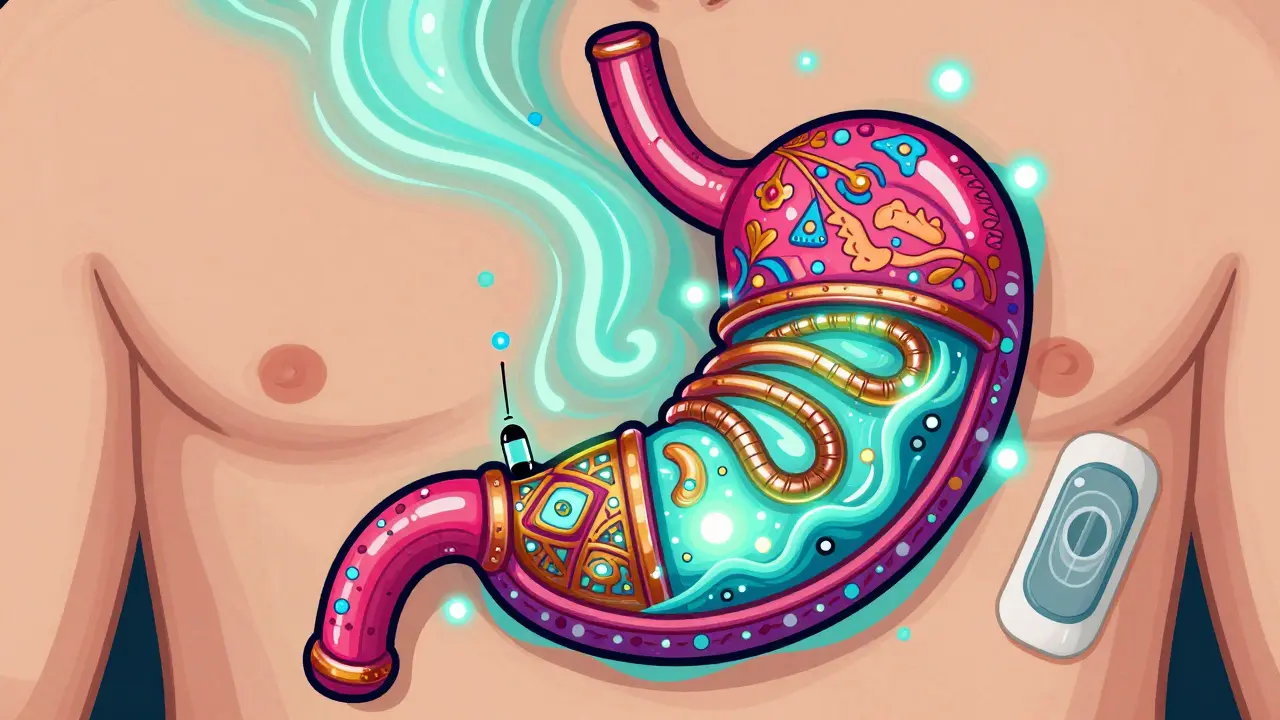
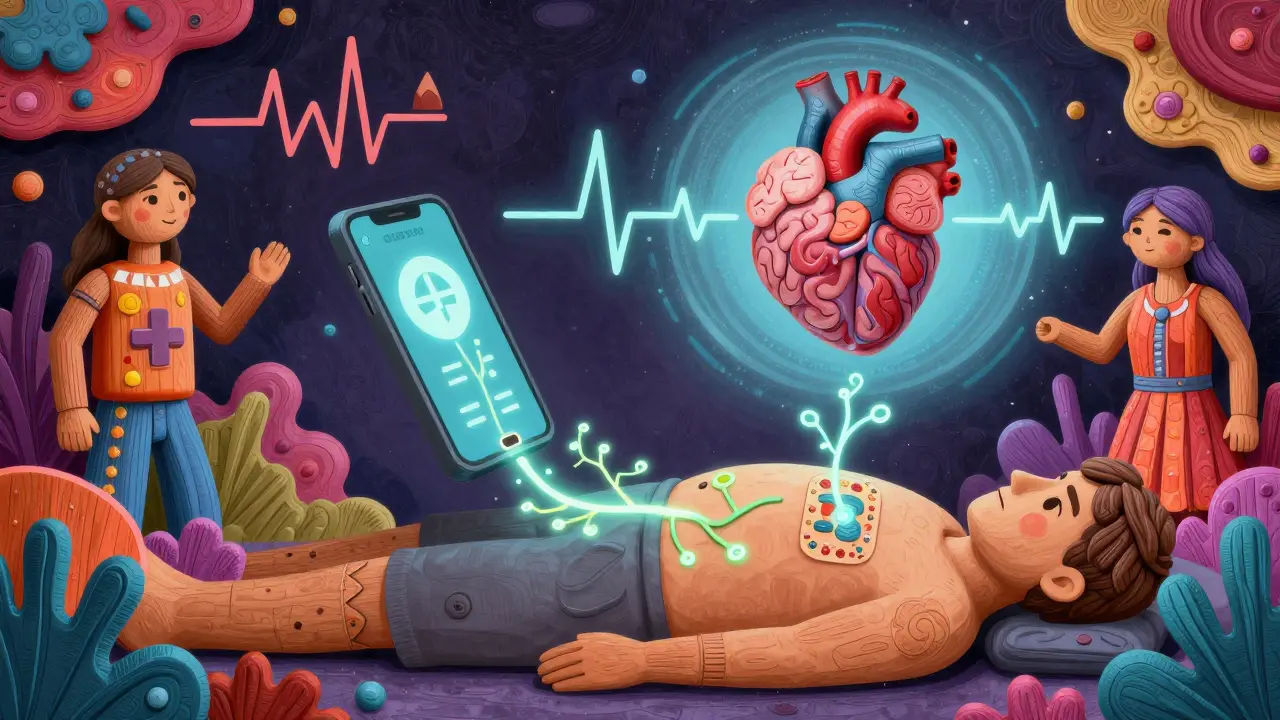
A digital pill isn’t magic. It’s a tiny sensor, smaller than a grain of sand, embedded inside a standard pill. When you swallow it, stomach acid activates the sensor. Inside, copper and magnesium react to create a tiny electric pulse-just enough to send a signal. That signal gets picked up by a patch you wear on your skin, usually on your abdomen. The patch then sends the data to your phone, and from there, it goes to a secure server your doctor can access.
The sensor itself is made of silicon and harmless metals. It doesn’t have a battery. It doesn’t need one. The power comes from your stomach fluid. Once activated, it transmits a unique code-like a digital fingerprint-that tells the system: “Pill taken at 8:17 a.m.” The patch also tracks your heart rate and steps. Some advanced versions, like the IntelliCap from Philips, can even measure stomach temperature and pH levels in real time.
This isn’t just about counting pills. It’s about understanding behavior. Did you take your blood pressure medicine after breakfast? Or did you skip it because you felt fine? Did you take your antipsychotic at night, then vomit an hour later? The system doesn’t guess. It records.
What It Measures: More Than Just Adherence
At first, digital pills were sold as adherence tools. And they work. In one 12-week study of patients with schizophrenia, adherence jumped from 62% to 84% when they used the system. People saw their own data. They realized they were skipping doses on weekends. They started setting phone alarms. They got back on track.
But now, the technology is doing more. The same sensors that confirm ingestion are being used to detect early signs of side effects. How? By watching your body’s response.
Take a blood thinner. If your heart rate spikes unexpectedly after taking it, the system flags it. Could be a reaction. Could be an interaction. Could be nothing. But now your doctor knows to check-not just when you show up with symptoms, but before you even feel them.
Or consider diabetes meds. If your stomach pH drops sharply after a dose, it might mean your body isn’t absorbing the drug properly. That’s not something you’d notice on your own. But the sensor picks it up. In clinical trials, systems now monitor for changes in temperature, pH, and even biomarkers through electrochemical sensing-all in real time.
By 2026, 60% of digital pill systems are expected to include side effect detection as a standard feature. That’s not a prediction. It’s a roadmap. The technology is evolving from a simple tracker to a live health monitor.
Who’s Using It-and Why
Digital pills aren’t for everyone. They’re mostly used where missing a dose can be dangerous.
- Mental health: 47% of current use cases. For people on antipsychotics like aripiprazole (Abilify MyCite), adherence isn’t optional. Missing doses can lead to hospitalization. The system helps patients and providers catch patterns before crises happen.
- HIV/AIDS: 18% of use. Even one missed dose can lead to drug resistance. Digital pills help ensure treatment stays effective.
- Tuberculosis: In March 2023, the FDA approved the first digital pill for TB treatment. TB requires months of daily pills. Non-adherence fuels drug-resistant strains. This system is saving lives.
- Transplant patients: Immunosuppressants must be taken exactly. Too little? Rejection. Too much? Infection. Digital pills help fine-tune dosing.
Pharmaceutical companies are the biggest users-not for patients, but for clinical trials. About 78% of digital pill deployments are in research. They replace unreliable self-reports with hard data. That means faster, more accurate trials. Fewer failed drugs. Better outcomes.
The Real Problems: Privacy, Cost, and Trust
It’s not all smooth sailing.
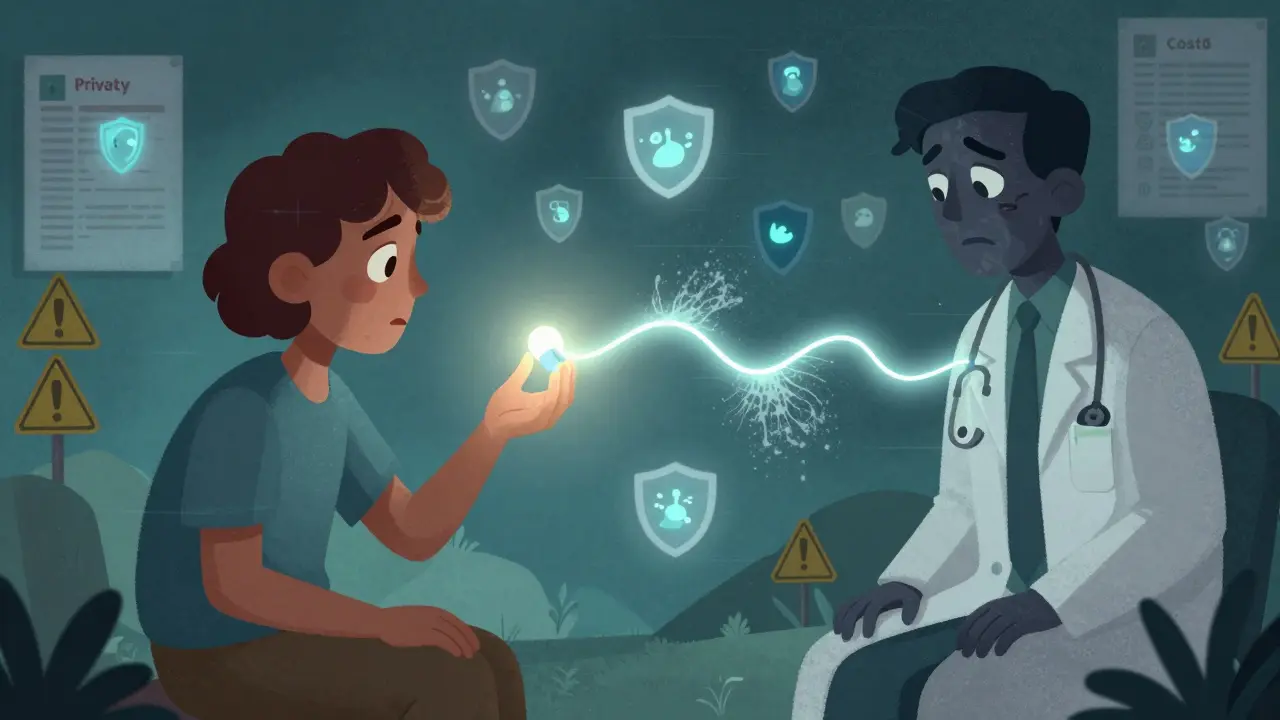
Privacy is the biggest concern. Sixty-five percent of patients in one study worried their doctor would judge them for missed doses. Some felt like they were being watched. One Reddit user said, “It felt like my psychiatrist was watching me swallow pills.” That’s not just awkward-it’s emotionally loaded.
Then there’s cost. A single digital pill can cost $10-$15. Add the patch, the app, and the data plan, and you’re looking at hundreds a month. Insurance rarely covers it. Medicare doesn’t. Most patients pay out of pocket. That’s why adoption is still limited to high-risk cases and clinical trials.
Technical glitches happen too. Signal transmission fails in 8-12% of cases. For people with higher body mass, failure rates jump to 18%. The patch can cause skin irritation. Some elderly patients struggle to connect the app. And the patch battery only lasts 72 hours. You have to remember to change it.
And here’s the kicker: the sensor confirms you swallowed the pill. It doesn’t confirm you absorbed it. You could take your pill and throw up five minutes later. The system still says “taken.” That’s a blind spot researchers are working to fix.
What’s Next: AI, Predictions, and Real-Time Alerts
The next wave isn’t just about recording. It’s about predicting.
etectRx teamed up with IBM Watson Health to build AI models that predict when you’re likely to miss a dose. The system looks at your past behavior, your sleep patterns, your phone usage, even the weather. It’s not guessing. It’s learning. Early versions are hitting 82% accuracy.
Imagine this: Your phone pings you at 9 p.m. with a gentle reminder: “You usually skip your pill on nights you watch Netflix. Want to take it now?” Or your doctor gets an alert: “Patient’s heart rate spiked 15 minutes after taking the med. Consider checking for reaction.”
By 2026, these systems will be smarter, smaller, and longer-lasting. Some prototypes are testing sensors that can detect inflammation markers or glucose levels directly from the gut. That’s not far off.
But the biggest hurdle isn’t tech. It’s trust. Can patients feel safe using this? Can providers use the data without creating shame? Can the system be fair, not punitive?
Is This the Future of Medicine?
Digital pills won’t replace doctors. They won’t replace your own responsibility. But they might change how care is delivered.
For high-risk patients-those on life-saving drugs, in clinical trials, or managing complex regimens-they’re already making a difference. They turn vague reports like “I think I took it” into hard facts. They catch problems before they become emergencies. They give people back control-not by monitoring them, but by helping them understand themselves.
Will they become routine? Probably not for everyone. Dr. Joseph Kvedar, a leader in telemedicine, put it best: “This will become standard for high-risk meds-but stay niche for routine ones.”
Cost, privacy, and practicality will keep them out of everyday use for now. But for the people who need them most? They’re not just useful. They’re life-changing.
Do digital pills track where I am or what I’m doing?
No. Digital pills only confirm when you swallow a pill and measure basic physiological data like heart rate and stomach conditions. They don’t track your location, your movements beyond step count, or your activities. The data is tied to ingestion events, not surveillance.
Can I remove the patch or turn off the sensor?
You can remove the patch at any time-it’s not permanently attached. But once you swallow the pill, the sensor inside activates and sends data as long as the patch is within range. You can’t turn off the sensor in the pill. It’s designed to be passive and always active once ingested.
Are digital pills safe to swallow?
Yes. The sensors are made of biocompatible materials like silicon and harmless metals (copper, magnesium). They’re smaller than a Tic Tac and pass naturally through your digestive system within a few days. They don’t cause irritation or interact with medications.
Can my insurance cover digital pills?
Most insurance plans, including Medicare, do not currently cover digital pills. They’re considered experimental or supplemental in most cases. Coverage is limited to specific clinical trials or rare high-risk cases. Patients usually pay out of pocket, which limits access.
Do digital pills work for all types of medication?
Not yet. The sensor must be embedded in a pill that can pass through the stomach without dissolving too early. That limits use to solid oral medications. It doesn’t work for liquids, injections, inhalers, or patches. Research is ongoing to adapt the tech for other delivery methods, but today, it’s mostly for pills.
What happens if the patch loses connection?
The sensor stores the ingestion data locally until the patch reconnects. If the patch is out of range for more than a few hours, the data may be lost. That’s why consistent patch wear and Bluetooth pairing are important. Most systems send alerts if connection drops for too long.
Can employers or insurers access my digital pill data?
No-not legally. Data is protected under HIPAA and is only accessible to your healthcare providers and the system’s authorized users. Employers and insurers cannot access it directly. However, privacy advocates warn that future breaches or policy changes could risk exposure, so strong legal safeguards are still needed.
If you’re managing a complex medication regimen-whether for mental health, HIV, TB, or after a transplant-digital pills offer something rare: clarity. No more guessing. No more assumptions. Just facts. And for some, that’s the difference between staying healthy and ending up in the hospital.


11 Comments
Write a comment