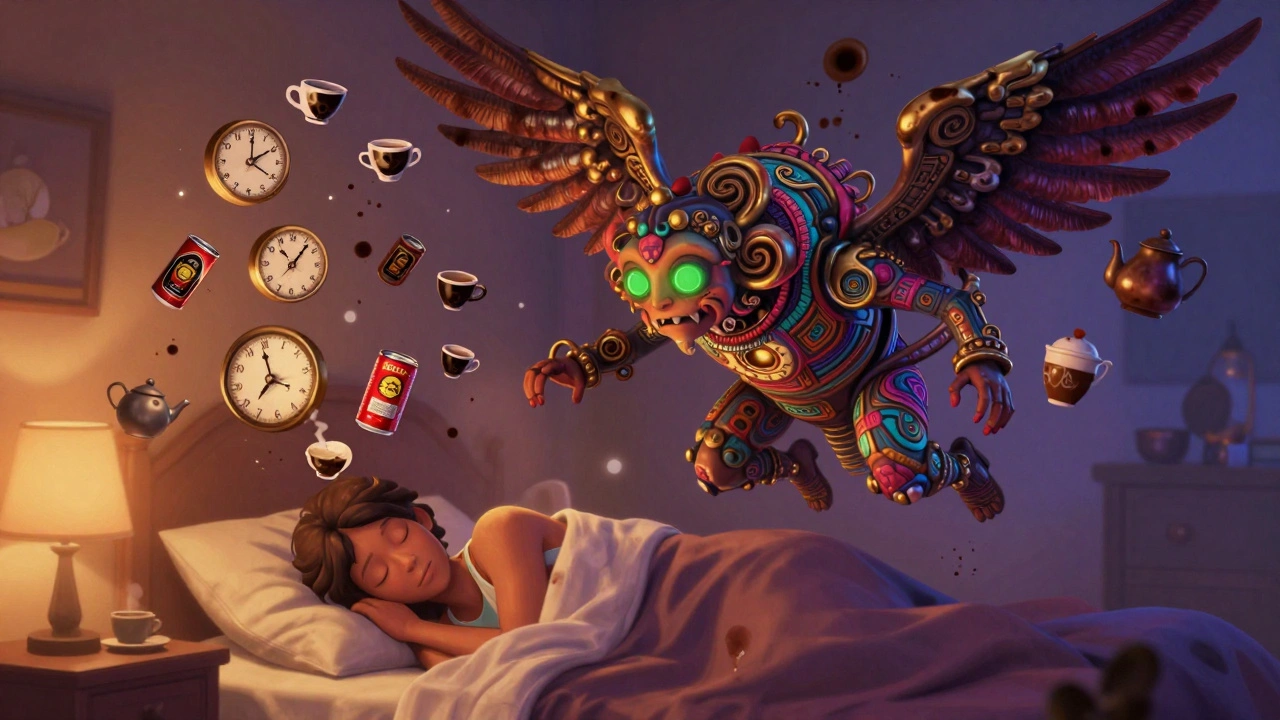
Most people think if they can fall asleep after drinking coffee at 8 p.m., then it’s fine. But falling asleep and sleeping well are two different things. You might drift off, but your brain is still buzzing. Your deep sleep? Reduced. Your restorative REM? Cut short. And you wake up tired, even after eight hours in bed.
This isn’t just about being jittery. It’s about biology. Caffeine blocks adenosine-your brain’s natural sleep signal. It doesn’t disappear when you swallow it. It lingers. For hours. The FDA says its half-life is 4 to 6 hours, meaning half the caffeine is still in your system six hours after your last sip. But that’s just an average. For some people, it’s longer. Much longer.
Why 6 Hours Isn’t Enough
A 2013 NIH study claimed 400 mg of caffeine (about four cups of coffee) taken six hours before bed disrupted sleep. That led to the popular advice: stop caffeine by 6 p.m. if you sleep at midnight. But that study used a massive dose. Real life isn’t like that.
A 2021 review in Sleep Medicine Reviews looked at 24 studies and found something different. A standard 8-ounce cup of coffee-107 mg of caffeine-needs an 8.8-hour cutoff before bedtime to avoid measurable sleep loss. That’s not a suggestion. That’s data. If you sleep at 11 p.m., you should stop coffee by 2:12 p.m. Not 6 p.m. Not even 4 p.m.
Why does this matter? Because caffeine doesn’t just delay sleep. It steals quality. The 2022 AJMC review of 18 studies found caffeine reduces total sleep time by 45 minutes, lowers sleep efficiency by 7%, and pushes sleep onset latency up by 9 minutes. That’s not a small tweak. That’s losing an hour of restful sleep, every night, for weeks on end.
It’s Not Just Coffee
Most people don’t realize how much caffeine hides in everyday things. A 12-ounce can of Red Bull? 80 mg. A single shot of espresso? 63 mg. Two Excedrin tablets? 65 mg. A pre-workout supplement? Some have over 200 mg. That’s not a coffee. That’s a sleep grenade.
For a pre-workout with 217.5 mg of caffeine, you need a 13.2-hour cutoff. That means if you work out at 5 p.m., you should’ve stopped caffeine by 5:48 a.m. That’s before breakfast. That’s not practical for most. But it’s real. And if you’re struggling to sleep, it’s likely why.
Black tea? Surprisingly, it doesn’t have a clear cutoff. It’s lower in caffeine, and the compounds in tea may slow absorption. But that doesn’t mean it’s safe late. If you’re sensitive, skip it after 3 p.m.
Age and Genetics Change Everything
Not everyone processes caffeine the same. A 2025 study in Nature Communications found middle-aged adults (41-58) are more sensitive to caffeine’s sleep-disrupting effects than younger people. Your brain changes. Your metabolism slows. What worked at 25 might wreck your sleep at 45.
And then there’s genetics. About 50% of people have a gene variant called CYP1A2 that makes them slow metabolizers. For them, caffeine’s half-life stretches to 12 hours. That means coffee at noon could still be active at midnight. If you’ve tried cutting caffeine at 4 p.m. and still can’t sleep, you might be one of them.
Companies like 23andMe now offer caffeine metabolism reports as part of their health tests. It’s not expensive. It’s not magic. But if you’ve been fighting insomnia for years, it could be the missing piece.

Real People, Real Results
Reddit’s r/sleep community has over 1,200 posts from people who switched from 4 p.m. coffee to 2 p.m. coffee. 78% said they had trouble falling asleep before. After the switch, 63% reported better sleep quality-even if they didn’t fall asleep faster.
A 2022 Sleepopolis survey of 2,150 people found those who stopped caffeine by 2 p.m. got 47 extra minutes of sleep per night and 8% higher sleep efficiency. One user wrote: “I switched from 4 p.m. to 2 p.m. and gained almost an hour of sleep quality. Eye-opening.”
Another study tracked 15,328 sleep logs from the Sleep Cycle app. People who followed the 8-hour cutoff reported 82% satisfaction with their sleep. Those who only stopped at 4 p.m.? Only 47% were satisfied.
This isn’t anecdotal. It’s measurable. And it’s repeatable.
How to Find Your Cutoff Time
Here’s how to figure out your personal cutoff without guessing:
- Track your caffeine intake for a week. Write down everything: coffee, tea, soda, energy drinks, chocolate, meds. Use an app like Caffeine Zone-73% of users in a 2022 review said it helped them stay on track.
- Set a baseline bedtime. If you usually sleep at 11 p.m., aim to stop caffeine by 2:12 p.m. (8.8 hours before).
- Test it for two weeks. No caffeine after that time. No exceptions. Track how you feel when you wake up. Are you less groggy? Do you need less coffee in the morning?
- Adjust if needed. If you still wake up at 3 a.m., move your cutoff to 1 p.m. If you’re fine, try 3 p.m. next week. Your body will tell you.
And if you can’t quit cold turkey? Switch to half-caf after 1 p.m. The AJMC review found this cuts sleep disruption by 32% compared to full-strength afternoon coffee.

The Bigger Picture
Over 35% of American adults get less than seven hours of sleep a night, according to the CDC. Caffeine is a silent contributor. It’s not the only reason-but it’s one you can fix.
Companies are noticing. Starbucks launched “Evening Brew,” a decaf line, in 2022. It captured 15% of the after-4 p.m. coffee market in six months. Oura Ring and Fitbit now give personalized caffeine cutoff alerts based on your sleep data. Philips SmartSleep is testing systems that adjust room temperature and lighting based on when you last had caffeine.
The American Academy of Sleep Medicine plans to update its guidelines in 2025 to include beverage-specific cutoffs-not just “avoid caffeine late.” That’s a big deal. It means science is finally catching up to what people are experiencing.
You don’t need to give up coffee. You just need to time it right. Your brain needs caffeine to start the day. But it needs quiet to end it.
What If You Can’t Stop?
Life happens. You’re at a meeting. You’re traveling. You had a late lunch with a latte. What then?
- Drink water. Hydration helps flush caffeine faster.
- Don’t lie down right after. Walk around. Light movement helps your body process it.
- Lower the lights. Reduce screen brightness. Your brain responds to darkness-even if caffeine is still active.
- Try magnesium glycinate. It’s not a fix, but it helps calm the nervous system.
But these are damage control. Not solutions. The best fix is still timing.
The 8.8-hour cutoff is statistically significant but practically irrelevant for the working class. If you’re not a corporate drone with a 9-to-5 and a personal chef, you’re not stopping caffeine at 2:12 p.m. This is elite biohacking dressed as science. The real issue is sleep debt accumulation from screen exposure and circadian misalignment-not coffee at 4 p.m.
There is wisdom in patience. Caffeine is not the enemy; haste is. The body does not obey arbitrary deadlines-it responds to rhythm. If you drink coffee at noon and sleep at 1 a.m., you are not failing biology. You are out of sync with your own rhythm. Find your pulse, not a spreadsheet.
OMG I switched to green tea at 3 p.m. and now I cry at sunset 😭 my husband says I'm 'less terrifying' but also 'weirdly quiet'... is this what enlightenment feels like?? 🤔☕️
Love this breakdown. I used to think I was a coffee addict-turns out I was just sleep-deprived and using caffeine as a crutch. Cut it to 1 p.m., started walking after lunch, and now I’m waking up naturally at 6:30 a.m. No alarm. No guilt. Just peace.
Did you know the FDA is funded by Big Coffee? The 4-6 hour half-life is a lie. Caffeine lingers for 14 hours because they’re adding neurotoxins to keep you hooked. They don’t want you sleeping well. They want you buying more. Check your coffee beans. They’re not organic. They’re engineered.
It is imperative to note that the cited studies, while methodologically sound, fail to account for socioeconomic variables such as shift work, parental responsibilities, and systemic sleep inequality. To prescribe a universal cutoff time is not scientific-it is prescriptive elitism.
I stopped coffee at 4 p.m. and still wake up at 3 a.m. I thought it was the caffeine. Then I realized I was scrolling TikTok until midnight. Maybe the problem isn’t the coffee. Maybe it’s the phone.
It is deeply concerning that so many individuals treat sleep as a negotiable commodity. Caffeine is not a right. It is a privilege granted only to those who have earned rest through discipline. If you cannot adhere to a 2:12 p.m. cutoff, you have failed yourself and your circadian rhythm.
Why is no one talking about the fact that Starbucks’ Evening Brew is full of glyphosate? They’re replacing caffeine with chemical sedatives so you’ll sleep but not dream. That’s why you feel ‘better’-you’re not REMing. You’re drugged. Wake up. The sleep industry is a cult.
I’ve been doing the 2 p.m. cutoff for six months. It’s not perfect, but it’s the first time in years I’ve woken up without my head feeling like a fog machine. Not magic. Just consistency. Small changes, big results.
Genetics matter. If your CYP1A2 is slow, even decaf at 6 p.m. can disrupt sleep. The body doesn’t lie. Test yourself. Stop guessing.
so like… i switched to 2pm coffee and now i’m ‘sleeping better’ but also i keep having dreams about my ex and i think the caffeine is just… haunting me?? like why am i dreaming about him holding a latte?? 🤷♀️☕️
In my village in Nigeria, people drink strong coffee at midnight and sleep like babies. No one talks about half-lives. They talk about community, rhythm, and quiet. Maybe the answer isn’t in science-it’s in culture.