G6PD Medication Safety Checker
Important: This tool is for educational purposes and is based on the provided article data. Always consult a licensed healthcare provider before starting, stopping, or changing any medication.
Safety Assessment
Safe Alternative / Requirement:
-
Related Guidance
Imagine waking up with a sudden, severe drop in hemoglobin-your blood's ability to carry oxygen-simply because of a medication you were prescribed for a different condition. For about 400 million people worldwide, this isn't a hypothetical scenario; it's a real risk known as G6PD deficiency is an X-linked genetic disorder that impairs the body's ability to protect red blood cells from oxidative damage. While most people with this condition live healthy lives without ever knowing they have it, certain drugs can trigger a massive breakdown of red blood cells, leading to a life-threatening crisis.
The goal here is simple: knowing which triggers to avoid and how to navigate the healthcare system to keep your blood cells safe. Whether you've been diagnosed or are managing a family member's health, understanding the relationship between this enzyme deficiency and specific medications is the only way to prevent hemolysis prevention and its associated emergencies.
How G6PD Deficiency Actually Works
To understand why some medicines are dangerous, you first have to understand what's happening inside your cells. Your body uses an enzyme called Glucose-6-Phosphate Dehydrogenase (G6PD) to produce a molecule called NADPH. Think of NADPH as a shield that keeps glutathione in a reduced state, which essentially scrubs away "oxidative stress"-the harmful molecules that can pop red blood cells like tiny balloons.
When you lack enough of this enzyme, your red blood cells are fragile. Under normal conditions, they hold up just fine. But when you introduce an "oxidative stressor"-like certain medications, naphthalene in mothballs, or even some fava beans-the shield fails. The resulting oxidative damage causes the cells to rupture and leak their contents, a process called hemolysis. In severe cases, hemoglobin levels can plummet by more than 50% within a single week, leading to anemia, jaundice, and potential kidney failure.
It's also important to clear up a common myth: this isn't just a "male problem." While it's an X-linked trait (meaning it primarily affects males), about 15% of females can experience hemolysis due to how X-chromosomes are inactivated in the body. Everyone at risk needs to be aware.
The Red List: Medications That Trigger Hemolysis
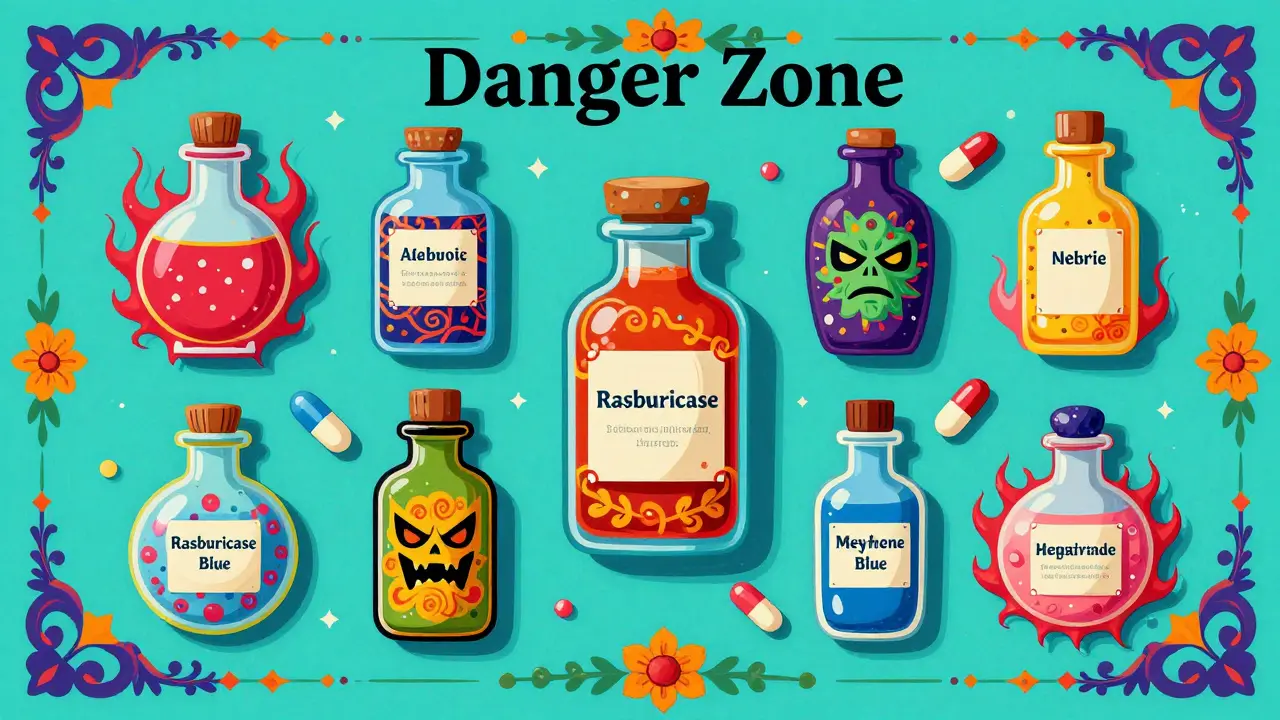
Not every drug is a threat, but a few are incredibly dangerous. The World Health Organization has identified 87 specific medications that can be risky. Some cause mild reactions, while others are catastrophic. For example, rasburicase is a drug used to treat high uric acid levels, but it carries an FDA Black Box Warning because it can cause a 100% hemolysis risk in deficient patients. A single dose can be enough to send a patient to the ER for an emergency blood transfusion.
Other high-risk triggers include:
- Methylene Blue: Used for certain blood disorders, this drug causes severe hemolysis in roughly 95% of deficient individuals.
- Primaquine: A common antimalarial that is highly dangerous for those with Class I and II deficiencies.
- Dapsone: Often used for leprosy or skin conditions; doses above 50mg daily are linked to an 80% risk of hemolysis in G6PD-deficient patients.
You might wonder why some people react more violently than others. It comes down to the variant of the deficiency. For instance, the Mediterranean variant is often ten times more sensitive to oxidative stress than the African variant (G6PD A-). This is why a "one size fits all" approach to medication warnings doesn't always work; the specific mutation dictates the level of risk.
| Condition | High-Risk Medication (Avoid) | Safe Alternative / Requirement | Risk Level |
|---|---|---|---|
| Hyperuricemia | Rasburicase | Allopurinol (Consult Physician) | Extreme |
| Malaria Prevention | Primaquine | Chloroquine or Malarone | High |
| Methemoglobinemia | Methylene Blue | Supportive Care / Oxygen | High |
| Malaria Radical Cure | Tafenoquine | Mandatory G6PD Testing First | Moderate to High |
Practical Steps for Safe Management
Since this condition is trigger-based rather than a constant disease, the "treatment" is actually prevention. The most effective strategy is a proactive approach to your medical records. Many doctors are simply unaware of these restrictions; surveys show that up to 42% of G6PD-deficient patients have had providers who didn't know about the necessary medication restrictions.
If you have G6PD deficiency, follow these steps to stay safe:
- Carry a Medical Alert Card: In an emergency, you may not be able to tell a doctor about your condition. A card or bracelet that explicitly states "G6PD Deficient - Avoid Oxidative Stressors" can save your life.
- Demand Pre-Therapeutic Screening: If a doctor prescribes a new medication, especially for malaria or cancer-related complications, ask if it is on the WHO list of oxidative triggers.
- Verify Testing Timing: If you've recently had a hemolytic crisis, do not get tested for G6PD immediately. There is a 72-hour delay in enzyme recovery, and because new reticulocytes (young red blood cells) have higher enzyme levels, your results might look "normal" even though you are deficient. Wait at least three months after an episode for an accurate reading.
- Use Point-of-Care Tests: If you are traveling or in an urgent care setting, ask for a fluorescent spot test. These can provide results in 15 minutes with very high accuracy.
Navigating Travel and Global Health
Traveling to regions where malaria is common adds a layer of complexity. Many traditional malaria treatments, like primaquine, are dangerous for G6PD-deficient people. However, you don't have to skip prevention. The CDC recommends using atovaquone-proguanil (Malarone) instead, which has been shown to be safe for nearly all deficient travelers.
If you are heading to a region where Tafenoquine is the standard of care, be aware that this drug requires a mandatory G6PD test before the first dose. This isn't just a suggestion; it's an FDA requirement to prevent severe anemia.

What to Expect During a Hemolytic Crisis
Despite your best efforts, mistakes happen. Knowing the warning signs of hemolysis can mean the difference between a quick recovery and organ failure. Look for these red flags shortly after taking a suspicious medication:
- Dark-colored urine: Often described as "tea-colored" or "cola-colored," this is caused by hemoglobin leaking into the urine.
- Jaundice: A yellowing of the skin or the whites of the eyes.
- Extreme fatigue: Sudden, overwhelming weakness due to the drop in oxygen-carrying capacity.
- Rapid heartbeat: Your heart tries to compensate for the lack of red blood cells.
If these symptoms appear, head to the emergency room immediately. Treatment usually involves intravenous fluids to protect the kidneys from the debris of broken red blood cells and, in severe cases, packed red blood cell transfusions to stabilize your hemoglobin levels.
Can I take common over-the-counter pain relievers?
Most common pain relievers like acetaminophen (Tylenol) are generally safe. However, you should always check with your doctor before taking high doses of aspirin or other NSAIDs, as some people may be more sensitive to certain formulations. Always read the ingredients for any hidden oxidative agents.
Are there any foods I should avoid besides fava beans?
Fava beans are the most famous trigger, but some people react to other legumes or specific foods like camphor or naphthalene (found in mothballs). While dietary triggers are less common than medication triggers, it's best to avoid fava beans entirely if you've had a reaction in the past.
Is G6PD deficiency curable?
No, it is a genetic condition, meaning it's something you're born with. There is no cure, but it is entirely manageable. By avoiding the specific medications and stressors that trigger hemolysis, most people live a completely normal lifespan without any symptoms.
Why is the timing of the G6PD test so important?
After a hemolytic crisis, your bone marrow pumps out a surge of new red blood cells (reticulocytes). These young cells actually have higher G6PD enzyme activity than older cells. If you test during this window, the result may be falsely normal, leading a doctor to mistakenly prescribe a dangerous drug.
Do all G6PD-deficient people react the same way to drugs?
No. The severity depends on the genetic variant you have. For example, those with the Mediterranean variant generally have a more severe reaction to oxidative stress than those with the African variant (G6PD A-). This is why quantitative testing is better than simple qualitative screening.
Next Steps for Patients and Caregivers
If you've just discovered you have G6PD deficiency, don't panic. The first thing to do is get a quantitative spectrophotometric assay. This test doesn't just tell you if you're deficient; it tells you how deficient you are (your enzyme activity level), which helps your doctor determine your risk category.
For those managing care for a child, ensure the school and any sports coaches are aware of the condition, especially regarding the use of certain medications during illness. If you are planning international travel, schedule a visit with a travel clinic at least six weeks before departure to secure the correct, safe malaria prophylaxis.
The point about the 72-hour delay in enzyme recovery is a crucial detail that often gets overlooked in standard clinical summaries. It's a classic case where the biology of reticulocytes can lead to a false negative, and emphasizing the three-month waiting period is a great way to ensure patients don't get a dangerously inaccurate result.
Oh, how quaint, a little guide for the masses. I'm sure the 42% of doctors who "didn't know" are just playing along with the pharmaceutical industry's little game of hide-and-seek with the WHO list. It's almost like they want us to stay in the dark about which "approved" drugs actually pop our cells like balloons. But please, by all means, keep trusting the system that forgets your basic genetic markers. 🙄
Pretty helpful stuff.
The correlation between the Mediterranean variant and higher sensitivity isn't just a biological quirk; it's exactly the kind of data point that Big Pharma uses to segment populations for targeted drug trials while ignoring the outliers. If you actually look at the pattern of which drugs end up on the "Red List," it becomes clear that these lists are curated to protect the manufacturers more than the patients. Just a thought for those who still believe the brochures.
It's really important that we keep the conversation inclusive here, especially for the 15% of women who might not realize they are at risk because of the X-linked nature of the condition. Everyone deserves to feel safe and informed when navigating their own health journey, and a medical alert bracelet is such a simple, effective way to provide a safety net for yourself and your loved ones.
The sheer negligence of the medical establishment is a moral failure of the highest order. We live in an age of information, yet we have patients wandering into ERs because a doctor couldn't be bothered to check a list of eighty-seven medications. This isn't just a "gap in knowledge," it's a systemic disregard for the individual's life in favor of bureaucratic efficiency. We must stop treating our health as a suggestion and start demanding absolute accountability from those who hold the prescription pad!
Actually the quantitative spectrophotometric assay is world class and we have some of the best diagnostic labs in India doing this efficiently 🇮🇳✨ why people always look to the West for medical standards when we are crushing it here 🚀🔥 purely superior tech honestly
It is a matter of national pride that our healthcare professionals are increasingly vigilant regarding these genetic predispositions. However, it is an absolute travesty that patients are forced to carry alert cards because the global medical infrastructure is too incompetent to maintain centralized, accessible records. One must maintain the highest moral standard of care, or else the entire profession is a sham.
I just can't even imagine the absolute terror of waking up and seeing that your urine is tea-colored and your heart is racing like crazy while you're just trying to get through the day 😭💔 it's honestly so overwhelming to think that a simple pill could do that to your body and I'm literally shaking just thinking about the anxiety of traveling to a new place and wondering if the local clinic even knows what G6PD is 😱😰
OH MY GOD! I knew someone who almost died because they took one of these meds and the doctor just brushed it off until they turned yellow! It is absolutely terrifying how quickly things go downhill! Does anyone know if there are specific brands of Tylenol that are safer or if they all have the same fillers?!
The imagery of cells popping like tiny balloons is such a wild way to describe it 🎈💥’ It makes the whole biological process feel like a weirdly tragic party in the bloodstream... kinda spooky but super helpful for visualizing what's actually happening. (⊙_⊙)
I am absolutely thrilled to see such a comprehensive guide being shared with the community because it provides a beacon of hope for those who have spent years feeling misunderstood by their practitioners! It is truly heartwarming to know that with the right precautions and a proactive mindset, we can transform a potentially life-threatening genetic quirk into a manageable part of a vibrant, healthy life! Keep shining and staying safe, everyone!
This is exactly why American healthcare is a joke. We have the best tech in the world but 42% of doctors can't read a basic contraindication list? It's an embarrassment to the country that we're relying on "alert cards" instead of a functional digital health system that actually works across state lines. Pathetic.